Field Trip 2: Media School Bayern – Educating the Next Generation of Media Professionals
Media & Journalism . Munich Media LandscapeHey everyone, welcome back to my blog. As part of our Media Institutions in Munich course at LMU, I once again had the opportunity to visit Media School Bayern. Some readers may remember that I already wrote about this organization during my first semester in Munich, when I visited it as part of the Professional Communication in Munich course. If you are interested in a more detailed description of the facilities, studios, and everyday activities, feel free to check out that earlier blog post as well.
https://exchange.ifkw.lmu.de/2026/01/19/field-trip-4-media-school-bayern-learning-by-doing/
Source: Author’s own photograph
This time, however, I wanted to take a different perspective. Rather than describing the visit itself, I would like to reflect on the role Media School Bayern plays in media education and the broader German media landscape. Visiting the organization for a second time made me pay less attention to the equipment and production processes and more to the question of why institutions like this are needed and what contribution they make to the future of journalism and media in Germany.
Media School Bayern is a non-profit educational organization based in Munich that provides practical media training for students and young adults interested in journalism, television, radio, podcasts, and digital media. Instead of limiting education to theoretical lectures, participants work in professional production environments and create real media content. Their training is supported by both public institutions and private media companies, creating an interesting partnership between education and the media industry. At first, I wondered why private companies would invest in such an organization. During our visit, however, the answer became quite clear: by supporting Media School Bayern, they also invest in a well-trained generation of future employees who already possess practical experience before entering the job market.
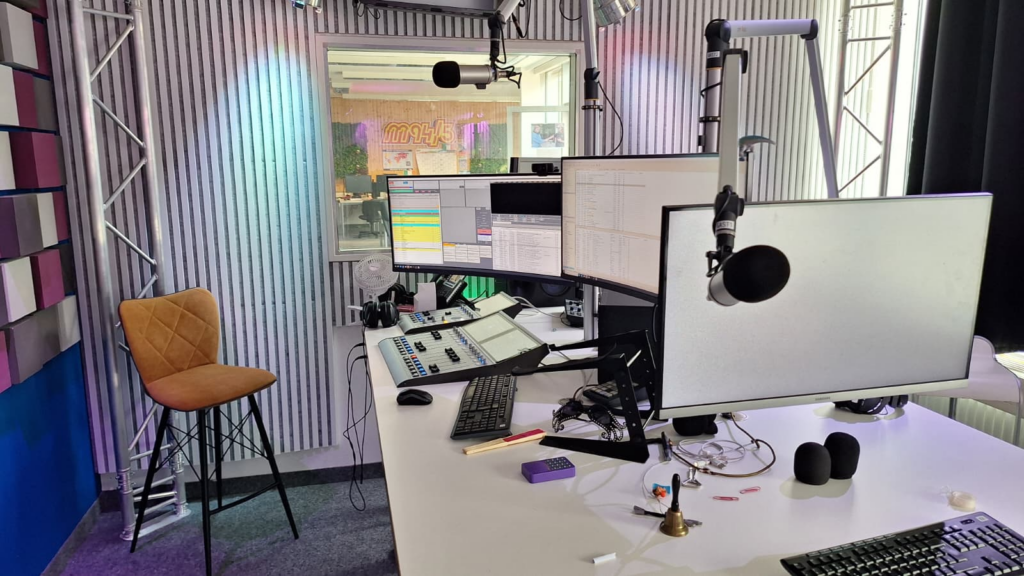
During the visit, we once again toured the studios and production facilities, but this time I found myself paying much more attention to the educational role of this institution. One particularly memorable moment was watching a group filming a creative challenge outdoors using a drone and, somewhat unexpectedly, cucumbers. It looked more like an entertaining game than a traditional media production, yet everyone was highly engaged and seemed to be learning naturally through the process.
This observation made me reflect on the educational philosophy behind Media School Bayern. Traditional university education often focuses on theories, concepts, and critical analysis. Here, the emphasis is on experimentation and learning by doing. Students are encouraged to test ideas, solve problems creatively, and collaborate in realistic production settings. These are skills that cannot easily be developed through lectures alone. Communication, teamwork, storytelling, technical competence, and adaptability all become much easier to learn when students are given real responsibility instead of only hypothetical assignments.
Source: Author’s own photograph
From this perspective, Media School Bayern fills an important gap within the German education system. It serves as a bridge between academic learning and professional practice, allowing students to experience the realities of media production before entering full-time employment. In a media landscape that is constantly evolving through digitalization, social media, and new storytelling formats, such practical experience has become increasingly valuable.
Source: Author’s own photograph
The organization also occupies an interesting position within the German media landscape. Although Media School Bayern produces real content, its primary purpose is not to compete with public broadcasters or commercial media companies. I actually asked whether the content they create is mainly informative or entertaining, and the answer was that it is intentionally a combination of both. Some productions focus on journalism and information, while others experiment with lighter, more creative formats. This reflects today’s media environment, where audiences expect reliable information but also engaging ways of presenting it. In this sense, Media School Bayern acts less as a traditional media outlet and more as a training ground where future journalists and content creators can safely develop their skills.
At the same time, I believe there is room for critical reflection. Watching students experiment with creative formats, such as the cucumber challenge we observed during our visit, I occasionally wondered where the line lies between professional training and recreational activity. If the organization aims to prepare future journalists and media professionals, it is reasonable to ask whether all projects contribute equally to professional development. Some activities may appear less serious than the work carried out in established newsrooms.
However, after reflecting on this question, I came to a different conclusion. Precisely because Media School Bayern is an educational institution, students are allowed to experiment, make mistakes, and try unconventional ideas without the pressure of commercial success. In today’s media industry, creativity, flexibility, and audience engagement are almost as important as technical knowledge. Therefore, what initially looks like “just having fun” may actually represent an effective learning strategy.
Another positive aspect that stood out to me is the organization’s commitment to preparing students for future careers rather than simply teaching technical skills. Participants learn to work in teams, meet production deadlines, communicate effectively, and adapt to different media formats. These competencies are highly transferable and explain why graduates of Media School Bayern are valued by many employers in the German media industry.
Source: Author’s own photograph
Overall, my second visit to Media School Bayern gave me a much broader understanding of the institution than my first one. Initially, I mainly saw it as an exciting place where students could gain practical experience with professional equipment. This time, however, I recognized its larger contribution to both education and the German media landscape. By connecting educational institutions, public support, and private media companies, Media School Bayern helps prepare the next generation of media professionals while encouraging innovation, creativity, and responsible journalism. Although it is worth questioning how closely every activity resembles professional media work, I believe its strengths clearly outweigh its limitations. In an era where the media industry is changing rapidly, institutions like Media School Bayern play an essential role in ensuring that future journalists and content creators are equipped not only with theoretical knowledge but also with the practical experience needed to succeed.
I hope you enjoyed my reflections on our second field trip. Some other trips are coming soon, stay tuned and see you next time. Servus!👋
Leave a Reply