A conversation with Parham
Interview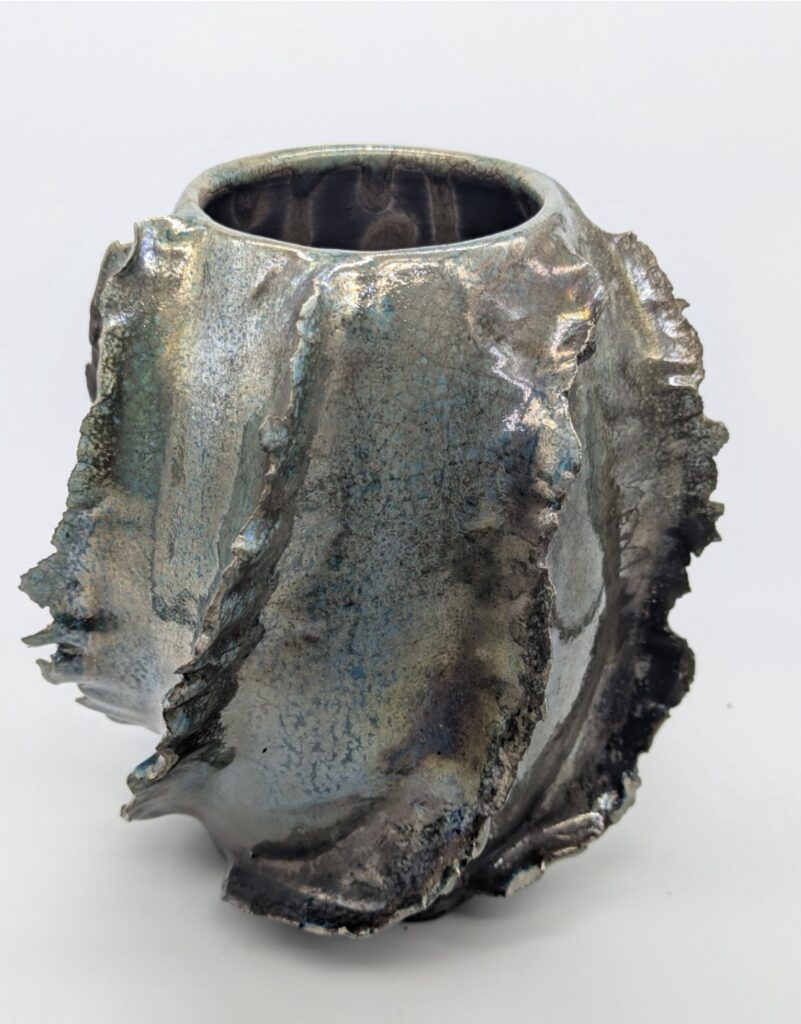
Interviewer: What is your name?
Parham Aghaei
Interviewer: What is your age?
Interviewee: 36 yr
Interviewer: How long have you been doing pottery for?
Interviewee: I would say about 3 years
Interviewer: What first sparked your interest in pottery?
Interviewee: Actually, it was kind of an accident, because I have been doing photography for a very long time, and I was part of the photo club. And the pottery club asked someone from the photo club to take pictures of one of their events.
So I went there to take pictures.
It was interesting for me, so I asked, can I join? They said, yeah, come to the next meeting, and I just started doing that.
Interviewer: What made you join the olydorf pottery club?
Interviewee: I just knew them during the photography session. So since, I like to work with my hands and doing crafts, I thought I would try it.
I have done carpentry before. So I enjoyed it, and I thought I would try that. Slowly I got the hang of it, I really enjoyed it.
Interviewer: How has your approach to pottery evolved since you first started?
Interviewee: I started learning the basics and failing usually, because It’s like riding a bike, if somebody explains you how to do it, you cannot do it. You have to do it a lot of times until you get the hang of it.
Something like pottery that’s between art and crafts. At first it’s technical for me, so I’m just trying to do a technique and do it right. it’s not very artistic and I’m not trying to make something new. But after you get the hang of the technique, you can start designing and going into details and making things more beautiful. So, I would say, learning the technique and evolving into doing kind of an art, but still learning the techniques.
Interviewer: What was your favorite piece of pottery that you’ve created?
Interviewee: That’s a hard question.I think it was a vase. I did one one. 5 years ago, I really liked but also I didn’t design it. So I saw a picture on Pinterest and I tried to replicate it.
Interviewee: Do you still have it?
Interviewee: I give my best pieces as gifts, so all the pieces I have are usually the ugly ones.
Interviewer: Which stage of the pottery process do you find the most rewarding?
Interviewee: Working on the wheel and throwing on the wheel is more interesting for me.
Interviewer: How do you come up with ideas for your pottery designs?
Interviewee: to be honest, I don’t design that much. It’s mostly something I see and I want to recreate it. But it can be a little different from the design and sometimes I improvise, but it’s mostly a copy. So that’s why I’m telling you it’s not many, it’s not considered art for me. It’s more of a technique. But throughout the times, I’m finding my own style. For example, I don’t like curves that much or I try to make angular and sharp edges. Before when I was doing carpentry as well, I really liked sharp edges.
Interviewer: Could you walk me through your process for creating your own glazes?
Interviewee: The glazes we have are mostly from the recipes that old members made many years ago.
So we have just a recipe and we follow it. But since last year, I started trying to make new ones or change the recipes a little.
So I had to study the chemistry of the glazes from different websites, YouTube, and books.
But, I don’t understand chemistry completely, so it has a lot of trial and error. For example, I make a base glaze that melts very good at the temperature we are burning our pieces. Then I add metal oxides to get the colour I want.
So, for example, I want to make something with iron, but I don’t know what the colour would be. So I will try iron at two, three, four, five, 6 percent and see which one is better. Then I’ll try to tweak it after a few times. Maybe I can get it, but it takes a very long time and a lot of trial and error.
Interviewer: How do you predict or control how different glazes will react with each other in the kiln? Or is it just testing?
Interviewee: A little I’m trying to understand how they react to each other, but that’s very advanced and I try to not mix the glazes. That’s a technique to have two glazes over each other. But it’s a little hard, actually. I try not to do that.
Interviewer: What is the most important lesson you have learned from pottery?
Interviewee: If you want to rush through it, you have to do it again.
Interviewer: What is the most challenging technique you’ve tried to master so far?
Interviewee: I’m still learning, and I’m still new to this. I think throwing tall pieces is pretty challenging.
But the thing I really want to start learning is making a moon jar in one piece. And that’s very advanced and I need to work on several different techniques before I can even try that.
You know what’s a moon jar?
Interviewer: No
Interviewee: Moonjar is like a vase that’s completely spherical, so the height and the weight of the vase is the same, so it looks like a circle.
Because of the very big curve that it has, if you make a little mistake, it’s just gonna collapse.
It’s super advanced, because people who are not very advanced make it in 2 pieces and attach them together. I didn’t try, maybe I can do that, but making a moon jar in one piece is really advanced.
Interviewer: What current piece are you working on now?
Interviewee: Right now, I’m trying to design some lampshades and start making them, so it’s just on the paper now. I haven’t started, but hopefully I will make some lampshades in the next few weeks.
Interviewer: Wow, with clay?
Interviewee: Yes, and the hard thing is, you have to calculate the shrinkage because when you get the lamp screw, it has a certain diameter, and if the clay shrinks too much and you can’t fit it into it, it doesn’t work at all.
Interviewer: How do you think pottery can bring people together since joining olydorf pottery club?
Interviewee: Everything you do with your hands, can make you a little occupied. Your mind would be more free, at least in my idea. But not when you are learning for the 1st time.
When you do it casually, I always see people start talking together in the pottery club.
So, it doesn’t happen that everybody’s silent and doing their own thing. Somebody starts saying something and the others comment on that. And it’s really nice, and mostly I’ve seen that during the advent events that we have in December and November.
Interviewer: What advice would you give for someone who is interested in starting their pottery journey?
Interviewee: I would say they have to be really patient and they have to remember the videos they see online or from people who have been doing pottery for decades.
Some of them have masters in pottery, and they do apprenticeships in different countries for many years.
So when they see somebody make a vase in one and a half minutes, and they can centre the clay for one hour, they will be frustrated.
They should know that it’s natural.