Not only one solution
Interview . Journalistic WritingI interviewed Anne, who is a German student at LMU. Her major is education. I met her for the first time when she became my buddy last September. She is interested in Japan and uses a PC with a Japanese keyboard. I was surprised because I had never met German people who used one. So, I decided to interview her. She has also been to Japan and studied Japanese before. I wanted to find out whether her experiences, such as studying and traveling, had changed her. After you finish reading it, you will understand what learning Japanese and traveling in Japan gave a German student at LMU.
Q. You major in education. Can you tell me more about it?
A. I study how people grow up and how you can educate them. A part of my studies is philosophy, so I learn about how it works and how you should teach. Another part of it is research methods, so we work a lot with statistics.
Q. Why do you use a PC with a Japanese keyboard?
A. I bought it when I was still studying Japanology. It is a bit hard to type Japanese script, so I decided to buy this one.
Q. How did you first get interested in Japan?
A. When I was younger, I started watching anime. When I grew up, they also showed it on TV. I mainly watched Sailor Moon and Detective Conan.
Q. I have heard you studied Japanese for a couple of years. What made you start studying it?
A. I’ve liked anime and manga. During school, I had to work somewhere. It was a bit like an internship. I did that at LMU, and they put me into the Japanology department. Being already interested in Japanese culture, I could try studying there. They made me interested in the field of Japanology.
Q. What was the hardest part of learning Japanese?
A. The script. I think it is very hard to study a language that you can barely read. Even if you know hiragana, katakana and a hundred kanji, you will very quickly find words that you cannot read. I think grammar is also difficult, but I think mainly the script is the hardest because you just have to repeat and repeat.
Q. You have been to Japan. Tell me about your experience there.
A. The first time, I went there with my mother for one week in 2022. It was very empty because it was after COVID. I stayed in Osaka, Kyoto, Nara, Tokyo and Kamakura. I also went there with my friends two years ago.
Q. As an education student, what do you think helped you most when you studied Japanese?
A. I think, in general, it can depend on the teacher, and which resources they give you. I think access to resources is a very important part. Also, we had one teacher who had a very good structure. Every lesson was the same. It was structured. She would always say, ‘Okay, today we’re talking about this grammar. You can say these things with this grammar. You can use it for this and that.’ She would give us an example, and she would give us multiple examples. Then we would have to give our own examples and share them with the class. And I think a clear structure can take a lot of mental load away. So, I think structure is very important in learning languages.
Q. Through studying Japanese and traveling in Japan, what changed for you?
A. I cannot say it always does, but it should always change the person’s perspective. I think it’s very important that we travel a lot. It just shows us that, although we are all living in the same world, there are different ways to do things. And I think it is a very good thing to keep in mind that, for example, if you have a problem, there is not only one solution for it. Everyone, every culture, every person feels differently. But it doesn’t matter if you look into Germany, or if you look at the whole world, if you compare Germany and Japan, you will always find differences between people. To acknowledge that and to see it as something valuable – I think that is what traveling can teach you.
This interview has been edited for length and clarity.
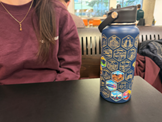
Anne at Stucafe
Photo: Risa Nakamura
Leave a Reply