Toward More Secure and Sustainable AI: A UDLAP Student on Federated Learning
InterviewArtificial intelligence has crept into the daily lives of most people, establishing itself as a cutting-edge technological and international topic and, behind that, as a major object of research for universities around the world.
Jatmajari García Vidals is a fifth-semester student in the Bachelor’s program in Computer Systems Engineering and Data Science at the Universidad de las Américas Puebla (UDLAP), Mexico, currently on exchange at Ludwig-Maximilians-Universität München (LMU Munich). Under the guidance of Dr. José Luis Zechinelli Martini, she is part of INFILTRARTE, an international academic project on Federated Learning.
Federated learning is an innovative area of study in the field of machine learning and artificial intelligence. The project seeks to use this model in an optimized way to propose solutions with a low economic and environmental impact. In this regard, Jatmajari talks about the importance of federated learning, its particularities, and its challenges and applications in the Mexican context.
This interview has been edited for length and clarity, and translated from Spanish.
Q. What is Federated Learning?
A. Federated learning is like machine learning; that is, it uses algorithms or mathematical models that learn autonomously. They are given many images or examples on which they operate with different mathematical functions and parameter adjustments in order to tell apart, for example, in a very simple way, a dog from a cat. The difference from traditional machine learning is that federated learning is more secure, because it does not share the training data, including private data, once the training process is finished, which is a major problem in conventional machine learning.
Q. How is it related to Artificial Intelligence?
A. The first concept that needs to be clear is machine learning, which is the foundation of artificial intelligence. Artificial intelligence learns on its own. That means that the more it interacts with humans, that is, with the prompts you give it and the tasks you ask of it, the more it adjusts its metrics on its own, so that the next user who asks it to write a text, say, about whales, gets it just as the many, many millions of people who asked for it before did.
Federated learning and AI are not separate, because they have the same basis and the same methodology. One thinks that when you write a prompt in ChatGPT, everything stays inside Google or your machine, so to speak. But no: you send the prompt and, encrypted, it travels through your internet connection to ChatGPT’s server. Then the server collects your data, not specifically your name, but it does recognize that the prompt came from a certain place, from a certain account, with this IP address, with this location. A lot of data that, if you stop to think about it, is sensitive. And then, when the server, with those gigantic machines, hard drives, and RAM, finishes training, that is, finishes doing the task you asked for, the result is sent back, also encrypted, through the internet cables, reaches your machine, and appears on your screen.
So what I mean is that at some point we are going to need a machine, a server, RAM, and a GPU to hold all this information, because when training on and reviewing millions and millions of data points, you obviously need a place to store them. But this model is not interested in, for example, where the prompt came from; it does not care who is asking for it.
Q. Why is it important to study Federated Learning?
A. Because of security. Machine learning is used in many fields. Right now, with this technological boom, you can use it in Artificial Intelligence to keep improving at tasks. But you can also use it in healthcare and in finance, for example to detect high-risk transactions, and so on.
For example, in healthcare, you can train a model so that, instead of having a thousand doctors reviewing a million cancer X-rays, you have a computerized model that can distinguish which X-rays show cancerous tumors and which do not. All of this is very, very delicate because, in a hospital, there is certain sensitive information. For example, the patient’s name, where they live, their age, among other things, which cannot be shared with everyone. That is where federated learning comes in: it is a model that does not care about the patient’s name, their age, or whether they are a man or a woman. It only cares about identifying, in the X-ray, whether the tumor is cancerous or not.
So that is the interesting part of federated learning, because it leaves out these traits, which in machine learning might perhaps play an important role when the model is trained. And this also involves the finance sector a great deal. When you are making a transaction and perhaps you were given a CLABE account number and you do not know whether it is really fraud or not, that is where federated learning can come in to review all of these transactions without the need to expose your real data, your name, the amount of money, or the transaction registration number, which would make you vulnerable to extortion or cyberattacks.
Q. What is the objective of INFILTRARTE?
A. The objective is to reproduce the model on a large scale so that it can be a practical, efficient, reliable, and secure approach for various fields. It could be in healthcare, in finance, in research, or in astronomy. And the idea of the project is to create a model with federated learning, but the limitation so far is that everything has only been tested in simulations. That is, in specific scenarios recreated by humans. It has not actually been put into practice. So what we want to do is break that barrier between simulation and practice and take it to a large scale.
However, one major factor is the economic and ecological impact. As we know, artificial intelligence is booming right now, and having a model with a million data points is extremely expensive because of the RAM and the conditions your computer needs. It is also because, as the model is continuously training, these training runs can last days or even weeks. So, while it is working continuously, the processor heats up and you need water to cool it down. The objective is to reproduce it, yes, with millions of data points, but without harming the planet and in a secure way, in the sense that there are no failures, since in the real world you are prone to being hacked, to receiving a phishing email, and to a lot of other cyberattacks. And under those unexpected circumstances, it is not known how the model will respond with regard to the security of your data.
Q. What is your role in this project?
A. My role in this project is to build the decision-making algorithm, that is, the reliability of the model.
There is also an ecological aspect: depending on where the server is located, it determines, for example, how much electricity it needs, how much water it needs, and how much voltage it needs, and it is not the same to train in Mexico as in Europe, Brazil, Austria, or India, because of the type of energy. And that is one of the project’s objectives: that not many ecological resources be used. Part of my work is to develop the algorithm so that it can decide in which location it is safest to train this data: so that it is faster and consumes less, both economically and ecologically.
Q. Which other universities collaborate on this project, besides UDLAP?
A. Our leader is Dr. Genoveva Vargas Solar. She is currently working at the University of Lyon in France, and she has two important collaborators: one in Paris and another in Italy.
Q. What are the challenges you face at UDLAP in Mexico when researching federated learning?
A. The biggest challenge is that federated learning is not supported, because it is a risk. All of this is still in simulation, and since it is simulated, it has no real results. So many people do not know whether to bet on this alternative, because it costs money, it costs time, it costs resources, and there is great doubt about whether it will end up working, how secure it will be, whether it is better than artificial intelligence, or whether it is better than other options. Another disadvantage is that there are no machines and no laboratories at UDLAP for training high-capacity models.
Q. What would be the benefits of developing a federated learning model?
A. In Mexico, we could apply it mainly in the healthcare sector. In the country we have two major government health institutions, the IMSS and the ISSTE. And there is often a shortage of medical staff to attend to the millions of patients there are. So, with this model, the process of reviewing CT scans, X-rays, and prescriptions could be sped up, as well as identifying what is lacking, which medications are needed and which are not, the organization of appointments, and so on.
Also in the financial field, with banks, and I believe in biological research, for cases such as identifying what the greatest pollution in the ocean is. All of this, even though it may seem unrelated to what we are doing with artificial intelligence, is about discovering patterns and providing solutions, which is also part of this work.
Q. What is the estimated duration of the project?
A. Honestly, I do not know. Within two years, I have to create this algorithm that can decide how safe it is to trust devices to train the model. But the objective of the whole project is that it can be reproduced. So I think there is no deadline; it will continue until it is completed. That could take up to four years.
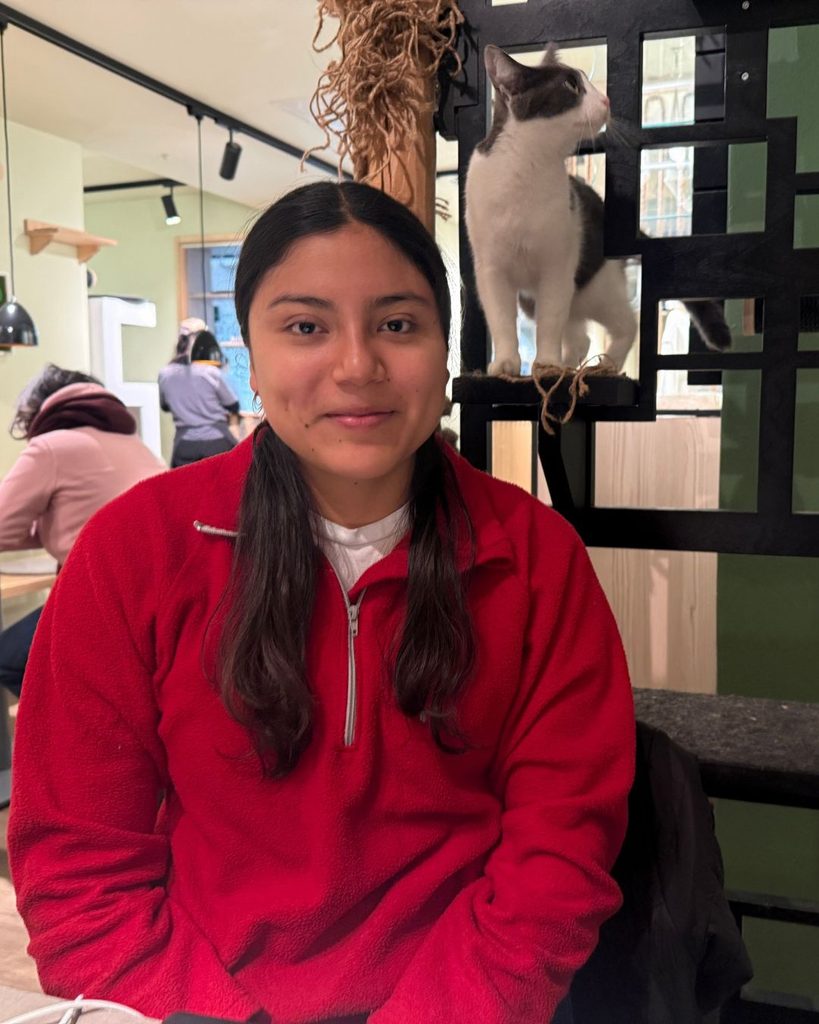
Portrait of Jatmajari García, by Lucía Huicochea 2026