Media School Bayern: A New Way of Learning Journalism
Munich Media LandscapeA space where creative freedom and hands-on experience become the main tools for training future communication professionals.
When entering Media School Bayern, one of the first things that stands out is the atmosphere. Despite being a space dedicated to the professional production of audiovisual content, there is none of the tension one might expect from a conventional newsroom. On the contrary, the atmosphere shows creativity and collaboration. Students work freely on their projects while developing skills that bring them closer to the professional world of the media.
Located in Ismaning, near Munich, Media School Bayern is a non-profit educational organization whose aim is to discover and train new generations of communication professionals. Through projects such as M94.5, in Munich, and max neo, in Nuremberg, it offers young people the opportunity to experience first-hand how the media industry works. Its educational model is mainly based on practical learning, known as learning by doing.
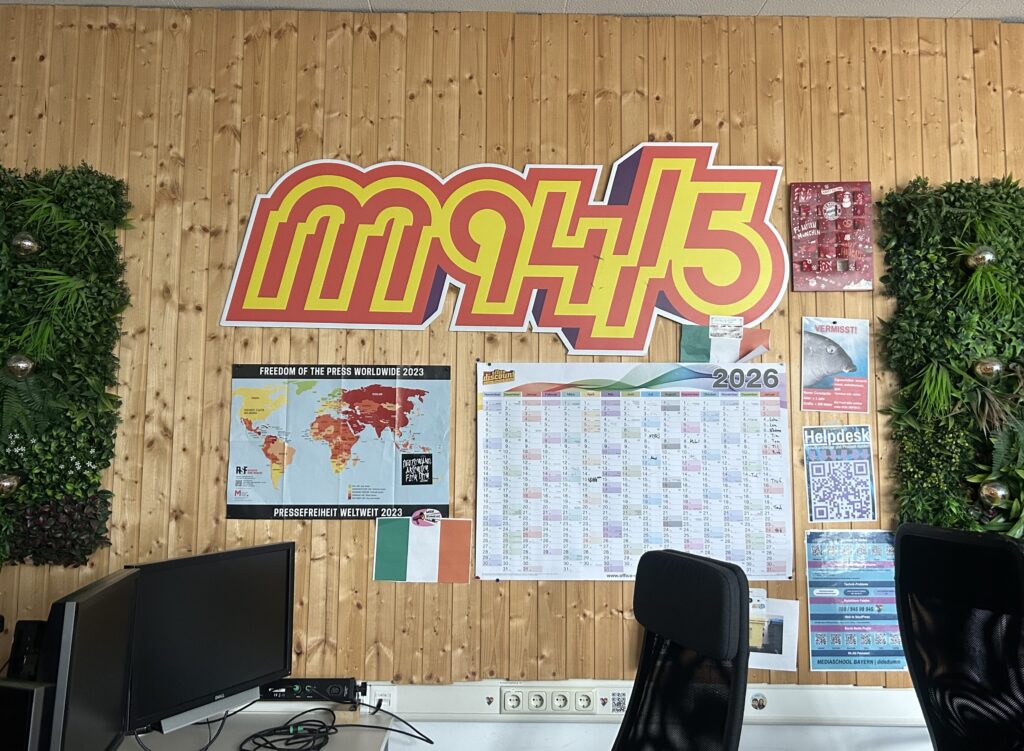
From Theory to Practice: A Newsroom in Action
During our visit, we were able to explore the different facilities that make this training possible. The building has several television studios, radio rooms for both pre-recorded programmes and live broadcasts, as well as dedicated spaces for podcast production. It also has facilities equipped with green screens, which allow students to create audiovisual content for social media, such as short videos, podcast clips and entertainment videos.
One of the spaces that stands out most is a room dedicated to the development of audiovisual projects, which is rented out for a period of six months. There, participants receive training in recording and editing before focusing on developing their own productions. In this way, they are not limited to studying theory but can experiment with their own ideas and spend time creating projects throughout the five days of the week.
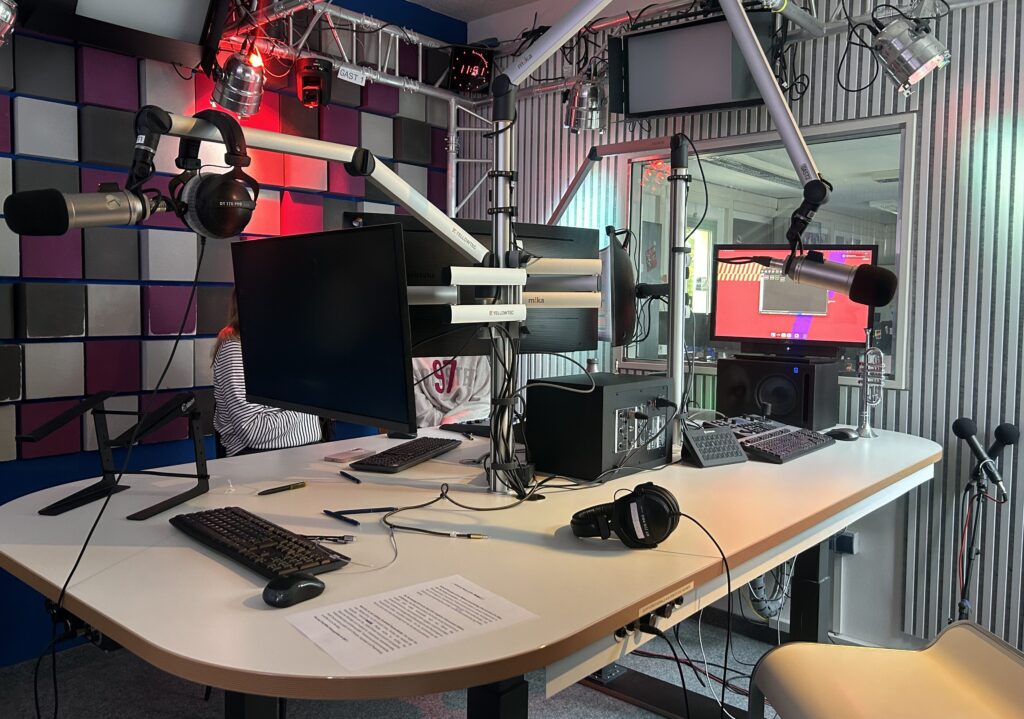
Although some participants may have previous experience related to communication, having worked in the media before is not a requirement to join. The organization mainly looks for people who are interested in the industry and willing to learn and take it seriously. In addition, students can combine this activity with their studies. In the case of the M94.5 newsroom, you can dedicate just one day a week to the general team and half a day to your assigned department.
Although it was a quiet day at Media School Bayern, we were able to observe how a newsroom operates on a daily basis. One of the staff members was supervising the content before it went on air, while two young women were working on selecting the station’s playlist for the week. These scenes showed that the training is not limited to simulated exercises, but that participants take part in real content production tasks.
Creative Freedom, but with Responsibility
One of the most interesting aspects of Media School Bayern is its funding and organizational model. Despite offering free training, it receives funding. According to the Bavarian Ministry of Social Affairs, the BLM is its main shareholder, alongside around 25 other private and public shareholders, including radio and television companies. The BLM currently holds a 62% share in Media School Bayern, according to its oficial information about its investments.
This support makes it possible to offer opportunities to young people interested in entering the industry. As we were told during the visit, its priority is to invest in education and prepare young people for their professional futures, rather than focusing exclusively on making a profit.
During our visit, I got the impression that there was less pressure and more space for students to experiment, make mistakes and develop their own ideas.
However, this freedom does not mean that students can publish any content without restrictions. During the visit, we discussed what criteria are used to decide which content gets published, and finding clear limits to provide objective information is not always easy. This is one of the challenges faced by media organizations, especially when working with a young audience.
Journalism Facing the Challenge of Artificial Intelligence
Technological transformation plays an important role in training future professionals. Nowadays, artificial intelligence tools can write texts, edit videos and generate content quickly. Therefore, learning how to use them responsibly is important.
On this subject, the newsroom team also highlighted the importance of learning to write independently before using artificial intelligence as a supporting tool. AI can be very useful, but it is important to understand how to use it ethically and not become dependent on it when you have to create your own texts.
This reflection reflects the idea that technology can facilitate journalistic work, but it should not replace the ability to think, investigate and develop our own skills. Learning to use these tools requires prior knowledge of the profession and what is needed.
A Different Way of Preparing Future Journalists
Our visit to Media School Bayern offered us a different perspective on education. This educational model focuses on teaching students about the real conditions of the media industry. Its main purpose is to give young people the opportunity to learn through experience, work with professional equipment and develop their own projects in a collaborative environment.
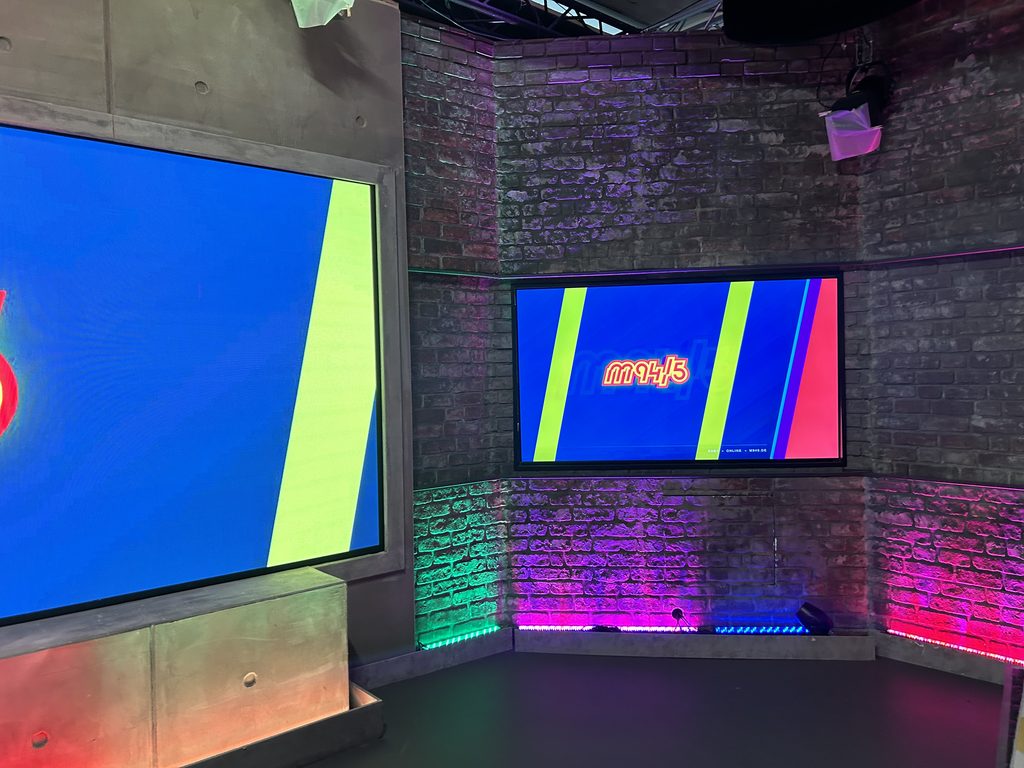
Although it is a very appealing model, I still wonder whether it fully prepares students for the demands they will face later in the job market. Creativity and freedom are essential for developing new ideas, but it will also be necessary to learn how to work with deadlines, editorial responsibilities and the economic difficulties of the industry.
Ultimately, Media School Bayern shows that learning journalism is not only about understanding communication techniques, but also about experimenting, making mistakes and developing our own abilities. In an industry that is constantly changing, training professionals who can adapt to new technologies without losing their critical thinking skills and ethical responsibility may be one of the greatest contributions of this model of education.
Sources
- Media School Bayern. Official website:https://www.mediaschool.bayern/map#m=1/750/450
- Bayerische Landeszentrale für neue Medien (BLM). Institutional information about Media School Bayern:https://www.blm.de/de/wir-foerdern/aus-und-fortbildung/mediaschool-bayern.cfm
- Ludwig-Maximilians-Universität München (LMU). Where budding media talent learns the ropes: https://www.lmu.de/en/newsroom/news-overview/news/where-budding-media-talent-learns-the-ropes-fffe28b1.html
- M94.5. Video & TV: https://www.m945.de/neben-dem-studium-an-die-kamera/
- Bavarian Ministry of Social Affairs. Information about Media School Bayern: https://www.stmas.bayern.de/ministerium/presse/pressemitteilungen/pm2607-265.php
- Bayerische Landeszentrale für neue Medien (BLM). Investments and memberships: https://www.blm.de/de/wer-wir-sind/beteiligungen_mitgliedschaften.cfm