Journalism in Transition: Learning from Munich’s Media Institutions
Media . UncategorizedBy Sangnan Hua
During this semester, I had the chance to visit and reflect on various media institutions in Munich. Each of them represents a different facet of Germany’s evolving media ecosystem—rooted in legacy journalism, education and access, as well as experimentation and innovation. Together, they offer a multifaceted understanding of journalism’s current challenges and possible futures.
A Diverse Media Landscape
Germany’s media landscape is remarkably diverse. For example, Süddeutsche Zeitung targets a well-educated, politically engaged audience through print and in-depth reporting. Media School Bayern focuses on educating young, aspiring journalists by offering hands-on experience and access to non-commercial radio stations like M94.5. Media Lab Bayern caters to media innovators and entrepreneurs who are experimenting with AI, accessibility, and user engagement. Each institution embodies a unique model of journalism in terms of structure, purpose, and audience engagement.
Education & Training in Journalism
Effective journalism training goes beyond technical skills. It must cultivate ethical judgment, critical thinking, and adaptability. Media School Bayern offers a bottom-up, democratized model where young people learn journalism by doing. Stations like M94.5 give students direct access to broadcasting, scripting, and technical tools, helping to cultivate the next generation of journalists in a non-commercial, supportive space. What impressed me most was the balance between autonomy and responsibility. Students are trusted to manage content creation, technical setup, and even program coordination—learning through doing in a real-world, low-risk setting. Meanwhile, Media Lab Bayern complements this with fellowships and innovation workshops, expanding journalism education into interdisciplinary domains like design thinking.
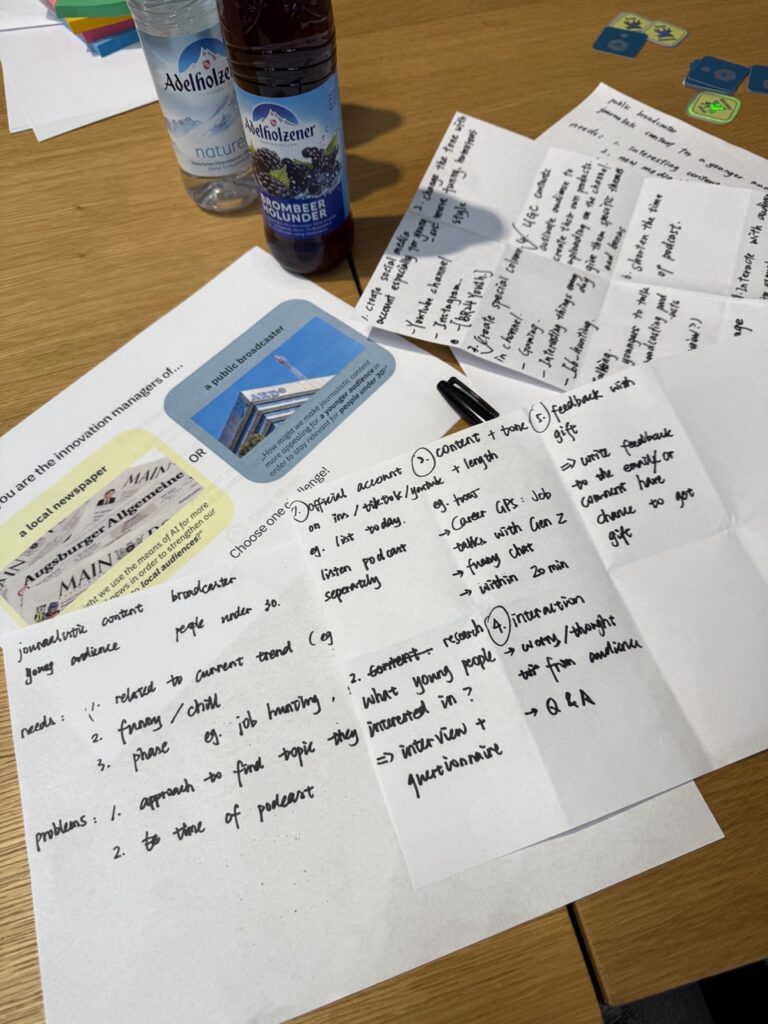
The Future of Journalism: AI as a Transformative Force
As journalism adapts to the demands of the digital age, one technology stands out as both transformative and contentious: artificial intelligence. Today, AI is rapidly altering not just how news is produced, but also how it is curated, distributed, and trusted.
In our visit to Media Lab Bayern, one of the most compelling examples was BR24’s AI-powered social listening system. Here, an algorithm scans user comments on social media and news platforms to identify relevant arguments, questions, or tips, then forwards them to editorial teams. This creates a feedback loop between the audience and journalists, ensuring public voices can shape—not just react to—news narratives. It’s a powerful use of AI to foster dialogue and deepen public engagement.
Another project involved AI translation of local news into dialects such as Plattdeutsch, making journalism more inclusive for local audiences. This effort not only addresses the digital divide but also reinforces local identity in an increasingly globalized media landscape. By using AI to localize news, journalism becomes more than a one-size-fits-all product—it becomes a personalized civic service.
Perhaps the most futuristic application was BotCast, an AI tool capable of automating the entire news production pipeline: script writing, video editing, voice-over creation with synthetic voices, and multi-platform distribution. In theory, a news story could be produced in minutes, at minimal cost, and deployed to multiple channels simultaneously.
While these applications offer efficiency and scalability, they also raise profound ethical questions. Can AI replicate the intuition, skepticism, and emotional intelligence of a trained journalist? Who is accountable when an AI-generated report includes bias, misinformation, or harm? Will the pursuit of speed and cost reduction compromise journalistic depth and human-centered storytelling?
At all these media institutions, the takeaway was clear: AI is not the enemy of journalism—but it must be handled with care. Used responsibly, it can enhance newsroom workflows, broaden access, and allow journalists to focus on deeper investigative tasks. But left unchecked, it risks accelerating sensationalism, automating bias, and eroding trust. Looking ahead, I believe the future of journalism will not be “AI versus human,” but rather a partnership of “AI with human purpose.” The best newsrooms will integrate AI as a collaborative tool—one that supports creativity, strengthens accountability, and centers the audience. AI should not write the story of journalism’s future, people should. And that story must be one of inclusion, responsibility, and trust.
Leave a Reply