From São Paulo to Munich: The comfortable silence
Authors . City life . SocietyI arrive in the northern part of Munich on a pale Saturday morning. The apartment building looks almost silent from the outside. Bicycles are chained neatly in front of it, a thin winter light pressing through the windows.
Inside the apartment complex, I step into the narrow elevator and press the button for the 4th floor. Just before the doors close, a neighbour slips in. He looks to be in his late forties, with neatly combed grey hair and a trimmed beard that frames a tired expression. His dark wool coat is still damp from the drizzle outside, and one heavy grocery bag pulls at his hand. Black over-ear headphones hang loosely around his neck. He gives me a brief, slightly awkward smile before his eyes fall to the soft light of his phone screen, as if retreating into a safer place.
“Good morning,” I say, and he looks up again, adjusting his glasses before nodding politely.
The elevator gives a soft ding, and I step out into the quiet corridor where most apartment doors are still closed for a slow Saturday morning. Down the corridor, when the door finally opens, Marina Barbosa stands there with cozy socks on, wrapped in a thick sweater, her hair still slightly damp after a shower. A soft smell of freshly brewed coffee drifts from inside, mingling with the faint scent of cold air that sneaks in from the corridor I came from.
She moves lightly, almost quietly, as if afraid of disturbing something invisible. “Sorry for the mess,” she laughs, although the apartment looks almost untouched. I can only see a stack of German textbooks on the table, a postcard from Rio pinned above her desk, and a blanket folded with careful precision on the couch.
Somewhere, low in the background, a Brazilian pop song plays from a small speaker, its rhythm warm and almost nostalgic. “It makes me feel like home,” Marina says, adjusting the volume. We both make ourselves comfortable at her table and Marina places two cups of freshly brewed black coffee in front of us. “I don’t have any milk so I hope this is alright”, she says.
It’s difficult to connect this calm, soft morning scene with a life that once moved so fast. In São Paulo, where Marina is from originally, silence was almost a luxury. Even inside office buildings, there was a constant hum of pressure, competitiveness and an unspoken rule that exhaustion was almost like a badge of honor.
At the young age of 22, Marina burned out in her full-time job in São Paulo. She remembers constantly rushing: through traffic, through deadlines and through expectations. “I was exhausted, completely,” she says, wrapping her hands around the coffee cup as if trying to warm herself from the inside. “There were days when I couldn’t think anymore. Not even about small things. Just nothing.”
She pauses for a moment, looking out the window toward the street, where a father in a thick jacket is pushing a stroller through the frozen air. The contrast is almost startling. Here, everything moves slower. But in São Paulo, the city never stops.
According to Marcelo Palhares Festa, Regional HR Lead for the Americas at Versuni Philips Walita, the average employee in São Paulo is overworked yet under-led, a paradox that keeps repeating itself across the city’s corporate landscape (The work culture in the city of São Paulo, Brasil.). Many companies value performance more than people, creating workplaces where leadership often becomes self-focused rather than supportive. Marina nods when I tell her this description.
She remembers evenings where she stayed long after her colleagues had left, not because somebody asked her to, but because nobody ever asked how she was doing. “You just keep working, because no one tells you to stop.” São Paulo offers higher salaries and endless networking possibilities, something highlighted by Devan Tremblay, director of marketing at Borderless AI. He describes the city as a magnet for ambitious professionals. Still, he notes that the intensity of life in this crowded metropolis can be overwhelming (Borderless AI / What’s the Work Culture Like in Brazil?).
The decision to leave came suddenly, like opening a door you didn’t realize was unlocked. Becoming an au pair wasn’t a dream, Marina explains. It was simply the most realistic way to leave.
“I applied without telling anyone,” she confesses, with a mischievous smile. “Not even my parents. Only when everything was ready – the tickets and the contract – I told them.”
Marina remembers her little sister bursting into tears and laughter at the same time, unable to decide whether to celebrate or panic. Her friends reacted even move dramatically. Apparently one of them nearly fainted. “I think she thought I was joking,” Marina says, shaking her head.
Then she stands up and walks over to her kitchen. She rinses her cup carefully before placing it back on the counter. I walk over to the shelf next to her table and take note of the few objects arranged there. Among them is a small brooch, decorated with the flags of both Germany and Brazil. I pick it up, turning it slowly between my fingers while I admire the details.
Marina notices me holding it and smirks.
“That one actually has a funny story, and I swear I am not kidding” she says. “I found this brooch on my desk back home in Brazil the same month I decided to leave. I still have no idea how it ended up there or where it came from.”
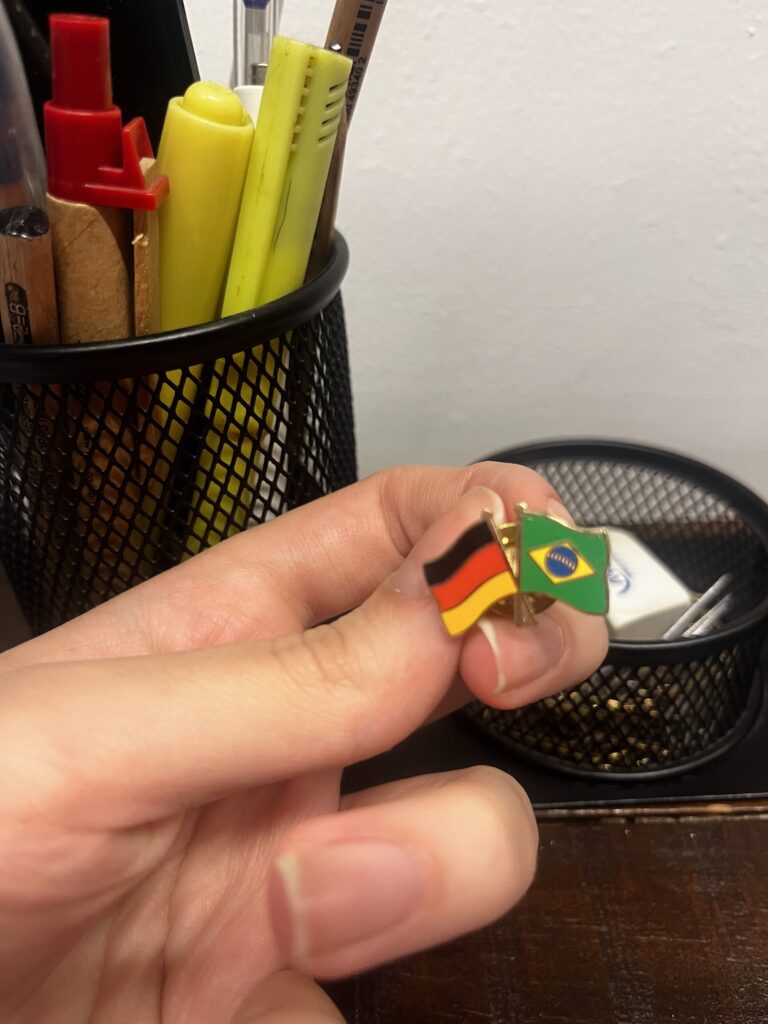
The pin on Marina’s shelf that caught my attention, captured by Tindra Karre.
Leave a Reply