Reading Between the Lines: Lessons from Munich Media (Final Blog)
ExcursionsAlfred Hitchcock, the filmmaker, was known for preferring to watch films in dubbed versions in order to focus more closely on images and visual composition. Being part of the Professional Communication course in Munich felt similar in some ways: as I look towards my professional career in the French media sector, I had to picture myself into different working environments we examined, concentrating primarily on the tasks being carried out while they were conducted in German, if not in English.
Applying these particular lenses to the field trips we accomplished enabled me to build a useful hindsight of the objectives and day-to-day missions of different media organisations. In particular, it highlighted how backstage work and frontline production are inseparable, and how their coordination is essential to maintaining journalistic discipline in contemporary media environments.
Visits to institutions such as Bayerischer Rundfunk (BR), Süddeutsche Zeitung (SZ), and Media School Bayern / M94.5 were particularly illustrative in this respect. Despite operating under different funding models (repsectively : public broadcasting fees, private revenues, or state-supported structures) all of these organisations emphasise editorial independence and the production of reliable, well-sourced information. Observing both formal newsroom settings and faster-paced student media, where topics are selected, produced, and broadcast or published within the same day, demonstrated how journalistic standards persist even as formats and rhythms evolve.
During these field trips, we were also given the opportunity to witness journalism becoming tangible. Whether it was the red “on air” light switching on in a radio studio or the rhythmic sound of printing presses, these moments felt like genuine performances, engaging all the senses. Yet they were only possible because of the coordinated work of hundreds, if not thousands, of people operating behind the scenes.
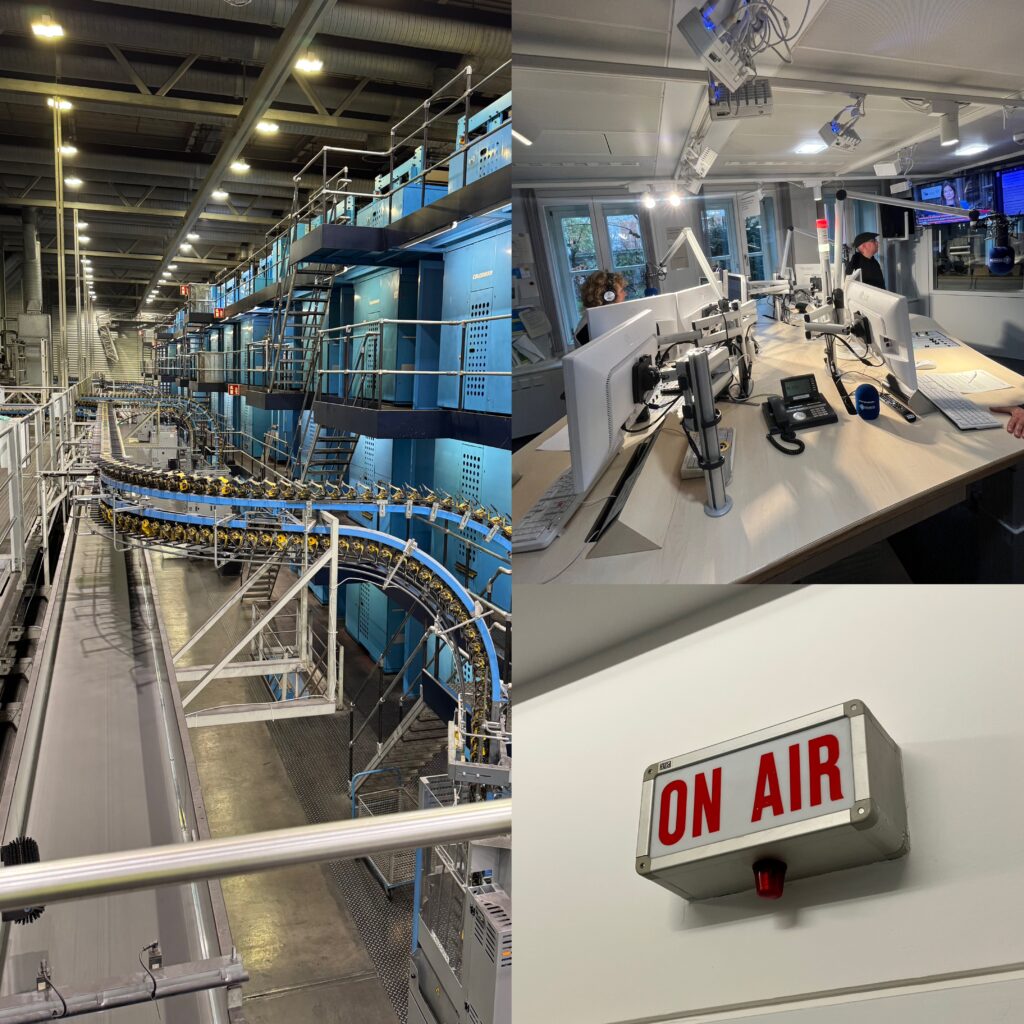
Left: Printing machines at Süddeutsche Zeitung. Top right: Bayerischer Rundfunk Bayern 1 radio studio. Bottom right: M94.5 “on air” in the recording studio. All photos by @liamcapgras.
Another key insight concerned the way these institutions adapt their strategies to their respective audiences. As a public broadcaster, BR prioritises maximum accessibility, for instance through the display of news screens across Munich’s underground and tramway networks. In contrast, Süddeutsche Zeitung primarily targets a more affluent and older readership willing to invest significantly in print journalism, including home-delivery subscriptions that can reach close to €1,000 per year. Nevertheless, this model appears sustainable only in regions such as Bavaria, and more specifically central Munich, where a sufficiently wealthy audience can support such levels of financial commitment to information and cultural capital.
The importance of journalistic rigour becomes even more apparent in the field of science communication. The presentation of the Munich Science Communication Lab (MSCL) demonstrated that knowledge production and knowledge communication, while closely connected, rely on distinct skill sets. Research activities prioritise methodological precision and theoretical depth, whereas communication work focuses on translating these findings into accessible narratives without oversimplifying their complexity.
This distinction was further illustrated during our visit to the Deutsches Museum, where curatorial work prioritises accessibility through creative and interactive learning experiences, with particular attention to language (whether through synthesised notes or short videos) to engage diverse audiences using artworks and historical artefacts.
Moreover, a significant insight from the MSCL visit concerned the risks faced by researchers when communicating publicly, including online harassment and broader forms of public backlash that I wasn’t aware of. In response, the lab has developed practices aimed at fostering safer and more supportive communication environments. This underscores an often-overlooked dimension of contemporary journalism and science communication: the necessity of protecting those who contribute to public knowledge while maintaining openness, and transparency.
The final field trip, to Media Lab Bayern, offered a forward-looking perspective on journalism and media innovation. As part of a broader network shaping Munich’s future media landscape, Media Lab Bayern supports and mentors startups addressing emerging challenges in journalism and communication. During this visit, we were asked to position ourselves as a public broadcaster tasked with designing media content for audiences under the age of 30. Applying “design thinking” methodology proved particularly instructive in understanding how innovation is developed, especially within startup environments where ideas serve as the primary drivers of more global industrial growth.
Through this exercise, we came to understand that as journalism evolves, the challenge is no longer simply producing content, but preserving rigorous and ethical communication within attention-driven platforms and amid the growing misuse of artificial intelligence.
Looking back at these experiences, I gained the analytical tools needed to better understand today’s media sector, while also realising how deeply the institutions we visited are embedded in Munich’s local context and in the economic strength of the Bavarian state. Whether in terms of audience targeting or institutional missions, many of these media organisations operate under conditions that would be difficult to replicate elsewhere, at least at a comparable scale.
In a nutshell, the experience offered a firsthand look at how media institutions operate in Munich, revealing how journalistic practices differ across formats and how innovation constantly reshapes professional roles. It confirmed my draw to fast-paced, experimental media environments, while also sparking an interest in strategic positions within established organisations, where I can both learn their inner workings and actively contribute to their renewal. Back in Paris, I plan to volunteer at Radio Campus Paris, a student station akin to M94.5, putting these insights into practice.
Leave a Reply