Old press & new pressures: Experiencing Süddeutsche Zeitung up close
Authors . Media & Journalism . Munich Media LandscapeWalking into the huge, loud space of the printing hall, I was struck by the scale and speed of the operation in Druckhaus Süddeutsche Zeitung. Our latest field trip gave us a behind-the-scenes look at how a traditional newspaper is trying to find its place in the digital age.
We met one of the employees who explained the complex journalistic structure: foreign correspondents all over the world together with a dedicated research team that focuses on fewer but deeper stories. Despite digitalisation and a 7-8% decline in print numbers in recent years, the physical paper still plays a central role for Süddeutsche Zeitung. 70% of digital subscribers also receive the print edition. According to the employee, they don’t follow one political line. Instead, the newspaper presents multiple viewpoints and often stages debates with pros and cons, encouraging readers to form their own opinions. The journalists work within certain quality standards but have a lot of freedom in their writing.
We also learned about the demographic of the news paper. The readers of the printed paper are mostly over 50 years old. But Süddeutsche Zeitung also has a strong digital presence, where (often younger) readers access the newspaper via the website and app, alongside its social media channels: Instagram, Facebook, LinkedIn and TikTok.
I was glad to hear that they are committed to adapting to today’s media landscape, also to be able to reach more people. At the same time, I got the feeling that Süddeutsche Zeitung position themselves towards a wealthier, more “intellectual” target group, which could be seen as something problematic. The representative casually mentioned that a yearly subscription costs 1,000€, a price that is out of reach for many. Even if running a newspaper is expensive, this raised questions within me about why access to supposedly high quality information should be limited to certain social classes.
I found it especially interesting to hear about how quickly Süddeutsche Zeitung must react when unexpected events happen worldwide. For example, during 9/11 they had to pull certain advertisements and change plans at very short notice, which shows how closely news production is tied to global events and economic interests. This visit made Süddeutsche Zeitung become something concrete for me: not just headlines and articles, but a complex system of technology, labour and audiences that has to stay flexible in order to keep informing the public.
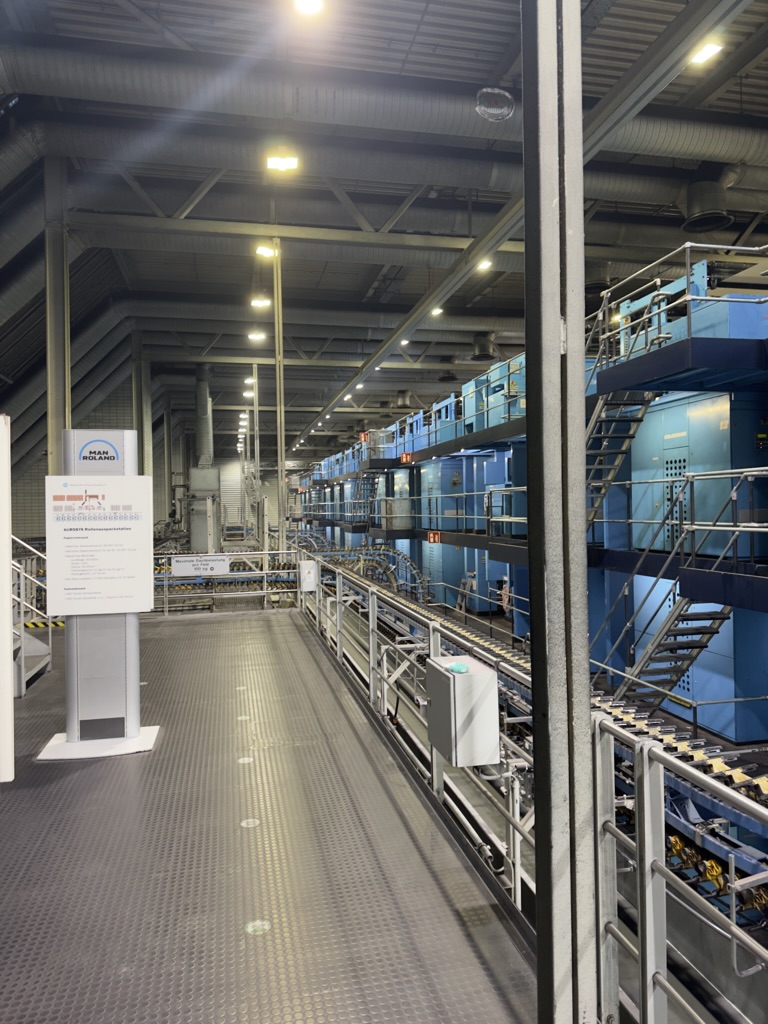
Inside Süddeutsche Zeitung 2025: the paper-cutting station, captured by Tindra Karre.
Leave a Reply