Field Trip 3: Süddeutsche Zeitung – Visiting a printing house, which will NOT become a museum in a few years
Excursions . GermanyHey everyone! I’m back again with another post from my Professional Communication course at LMU. This time we visited the printing house of Süddeutsche Zeitung (SZ) in Munich, and honestly, I was surprised how alive and busy everything still is.
Our guide was Michael. He began the tour with a clever remark: some people assume a printing house like this will become a museum one day, so it’s worth visiting now while it’s still working. But Michael disagreed. He said he believes printed newspapers will still exist in 10 or 20 years, even if many don’t expect that.

Source: Author’s own photograph
Inside, the atmosphere was impressive. SZ still prints a large number of papers every day, showing that print continues to play a major role alongside its digital presence. At the same time, many readers today access news online via SZ’s digital editions. Younger people in particular mostly use the online version, while the printed edition remains more popular among older readers (50+).
During the visit, Michael explained how SZ sees itself not as an outlet with a fixed political mindset, but as part of a democratic media: their goal is to present diverse viewpoints and avoid opinion bubbles. Even though the majority (82%) of the publishing company belongs to publishers from Baden-Wüttenberg, editors retain full independence: there’s no censorship, and they are free to report whatever they find relevant.

Source: Author’s own photograph
One of the most fascinating parts was seeing the printing machines in action. But before that Michael showed us both the old machines, and how newspapers were printed in the past, and modern machines, rolling paper in large reels and printing at high speed. I had no idea newspapers were made so efficiently. He also mentioned experimental ideas what they have tried: special editions with different size formats, even scented papers, or printed adverts with creative tactile designs (for example, a special ad by BMW where the paper felt like a car interior). At this point a question came to my mind: Why is the normal format of the newspaper much bigger than an average book or diary? I know that newspapers were always printed in this huge format, but why? It is not so practical, it is difficult to carry with us and so on… So why did they start to print it in this format? (Since I didn’t get an exact answer for my question, I had to do some research at home. I will share what I found out, at the end of the post.)
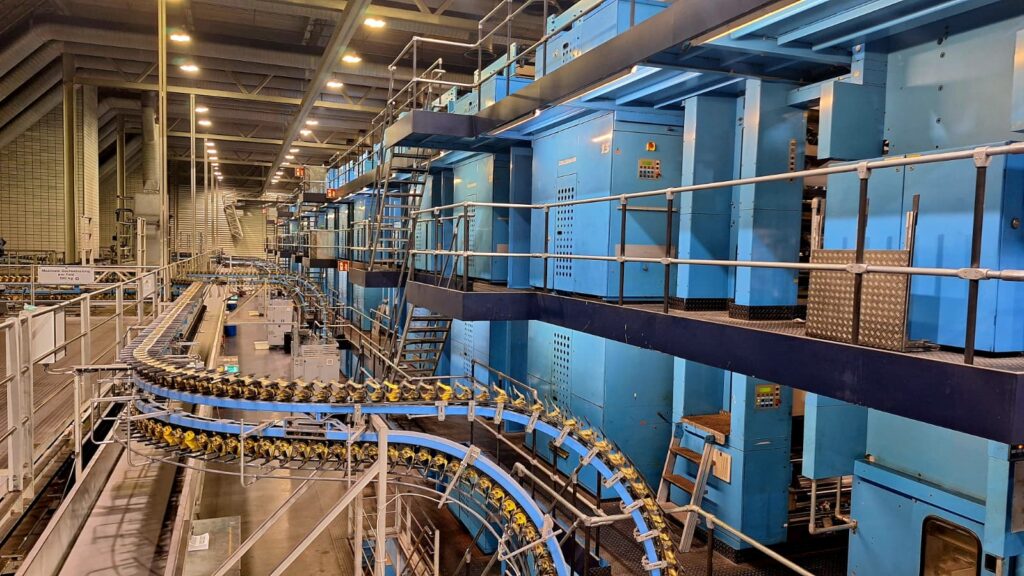
Source: Author’s own photograph
They also pay attention to sustainability: the heat from the printing machines is reused to save energy, which I found quite forward-thinking. Michael told us that even on very busy days, like after major events, the printing house can respond quickly. For example, on 9/11 they had to re-edit and re-print some parts after the “normal” edition was already finished. That showed me how demanding and responsible journalism can be.
This trip really changed my view. I used to think print media was dying soon, but seeing this printing house alive and evolving gave me hope. It’s amazing how much work, technology, and creativity go into producing a daily newspaper. I’m glad I got this behind-the-scenes insight, it made me appreciate journalism a lot more.
Bis bald and stay tuned for the next post! 👋
P.S.: Sorry, I almost forgot to tell you about the size of the newspaper.😅 In short, newspapers became so large mainly because of practical and economic reasons. Early printing presses could print more pages at once by using one big sheet of paper, which made production faster and cheaper. In some countries, newspapers were even taxed per page, so using large sheets (that could be folded into four pages) helped avoid higher taxes. Over time, this big format also became a symbol of serious, high-quality journalism. So even if today it feels impractical, the tradition stayed because the large size was efficient in the past and later became part of the identity of trusted newspapers.
Leave a Reply