Behind the Mic:
Media . Uncategorized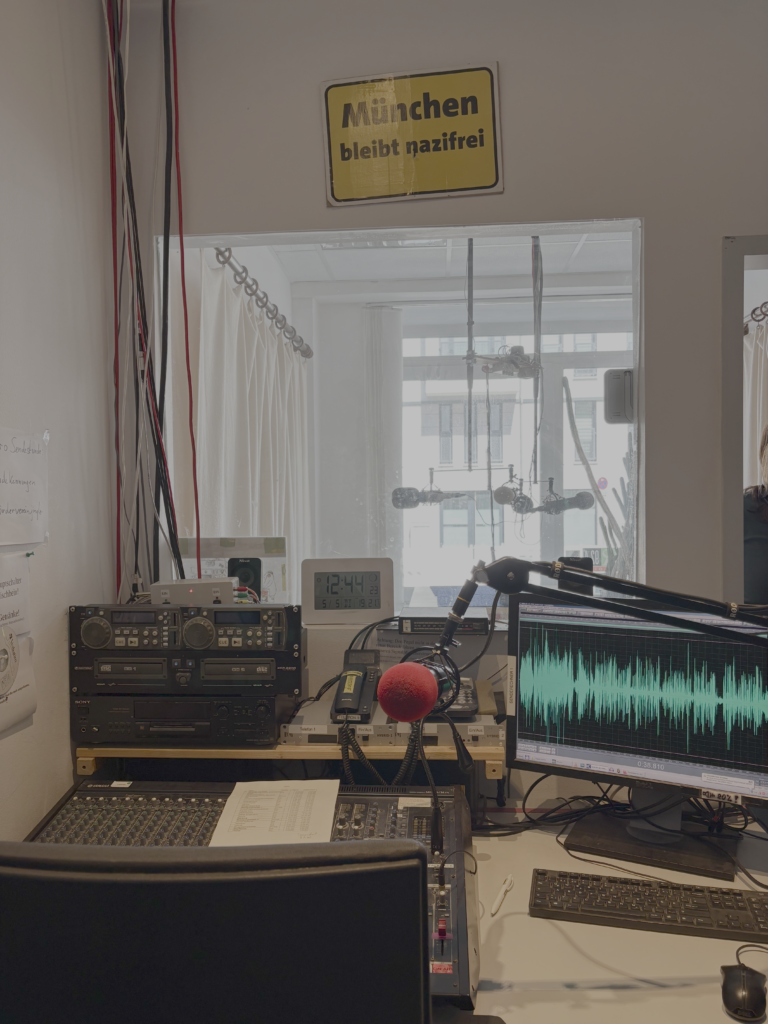
For our latest field trip, we traded the classroom for the gritty, fascinating world of independent media.
We visited the studio of Radio LORA München.
Walking into the studio, one could immediately feel the history. Our host for the day was
Karin Bergs, who gave us the ultimate insider look at how this unique machine runs.
The atmosphere was an incredibly welcoming mix of high-stakes broadcasting and cozy
community center. Karin told us about some of their legendary past and present
programming.
For example:
• They hosted a live cooking show. Guests would bring a mobile hotplate directly into
the studio. Listeners could actually hear the onions frying live on air while the hosts
debated wine pairings!
• Or a late-night slot where two cabaret performers read historical erotic literature.
Karin shared a hilarious story about her neighbour who tuned in past midnight
expecting to pray the rosary on the shared frequency—only to find himself right in
the middle of this intense reading!
The wildest thing about Radio LORA is: everyone works for free. It is a private, non-
commercial, volunteer-run radio station owned by a non-profit company with 10
shareholders and a booster club.
While German public broadcasting relies on mandatory household fees and commercial
stations live off ads, community radio relies entirely on volunteers. But as Karin reminded
us: “We are here in Bavaria, and in Bavaria everything is different.” Unlike other German
states, Bavaria does not give community radios a slice of the radio license fee.
To keep the lights on, it costs roughly €100,000 per year to cover rent, energy, and
technology. Yet, their funding situation is a constant uphill battle:
• The station’s booster club is shrinking, currently sitting at fewer than 500 members.
• They receive no corporate sponsorships.
• The Munich social department funded two temporary coordinator positions in 2026,
but only for a brief 9 months.
During the COVID-19 pandemic, the station faced a bizarre paradox: they were legally
forbidden from shutting down because they were deemed “system-relevant”
entertainment. Yet, because they are volunteers and not regular employees, getting
nighttime curfew travel permits for their late-night music DJs was a bureaucratic
nightmare. System-relevant, but €0 in state funding! When they took an online petition to
the Bavarian State Parliament to change the Media Act, politicians essentially told them in
thick Bavarian slang: “What do you want? This is Bavaria—we are a free country.”
LORA (short for Local Radio) was inspired by a station in Zürich and dates back to 1986.
Their history is a masterclass in survival:
• When they first got an FM frequency in 1993, they were forced off the air after just
26 minutes because a rival commercial station wanted exclusive rights. They fought
back and won 2 hours a day.
• In 1994, they almost went bankrupt because they forgot to air their legally required
“station identification” (the imprint details) once a day, resulting in massive fines up
to €10,000 from strict German authorities.
• Since 1994, they’ve been on 92.4 FM, but they have to share the airwaves with
other stations—like a Christian radio and a children’s radio. Today, they host a live
program from 4:00 PM to midnight, while the rest of the day runs on an automated
replay loop.
The media regulator strictly monitors everything LORA broadcasts. Fortunately, they are
pretty tolerant of LORA’s occasional mishaps, chalking them up to “stupidity, not intent”.
But here is the most fascinating, existential takeaway to me from our trip: LORA has no
idea how many people are actually tuning in. There are no official listener metrics. Maybe
it’s 1,000 people; maybe it’s 50. A past marketing manager did a brutal analysis concluding
that from a mainstream entertainment perspective, “nobody is interested” in their hyper-
specific content. The music shows are highly eccentric, the programming is aimed entirely
at localized minorities, and they host a rotating door of interns.
But does the lack of data mean they aren’t relevant? I don’t think so.
Public broadcasting is legally mandated to provide “balanced” programming, which often
results in polished, safe, corporate spokespersons who all sound exactly the same. Radio
LORA doesn’t want balance; it wants to activate people. It hands the microphone directly
to non-professional journalists, political activists, and international communities
(broadcasting in Polish, French, Spanish, and more). At LORA, the philosophy is simple: if
you feel a group is missing from the airwaves, don’t complain—come in and make a show
yourself.
Our trip to Radio LORA showed me that media isn’t always about chasing algorithms,
ratings, or ad revenue. Sometimes, it’s about a group of passionate volunteers crammed
into a room, keeping the spirit of free speech alive on the 92.4 FM frequency, just so the
marginalized can have a place to speak.
Sources: my notes, Skript from Karin Bergs
Leave a Reply