The disappearing of Italy and its cold, demographic winter
Culture . Reportage . SocietyThere is a sound that is growing increasingly rare across vast areas of the Italian peninsula: the chatter of children leaving school and their laughter while playing all afternoon in that small park amongst the flats and houses.
From the ridges of the Apennines to the valleys of the Alps, and across the inland territories of Sardinia and Sicily, Italy is undergoing a silent (yet inevitable) transformation.
It is not an earthquake, nor a flood. It is the demographic winter.
Imagine a tiny village in southern regions like Molise or Basilicata. The dark green shutters are closed, the squares are empty, and a deafening silence crosses the streets. It fully reflects the hard truth of the country: it’s average age, which, in some municipalities, exceeds 60 years. This is not merely folklore for tourists seeking “authenticity”. It is the symptom of a nation that is steadily shrinking.
The unforgiving numbers (2024–2025 data)
The most recent data from ISTAT (Italian National Institute of Statistics) is clear, though scary, as it confirms a trend that appears irreversible without drastic intervention. International bodies like the European Union’s Eurostat and the UN Population Division frequently highlight Italy as a case study in advanced aging economies.
In 2024, births dropped below the statistical and psychological threshold of 370,000 units, a decline of nearly 10,000 newborns compared to the previous year. This is a new record of the country.
The fertility rate hovers at 1.18 children per woman, far below the replacement rate of 2.1 necessary to maintain a stable population. This figure places Italy among the lowest in the world, alongside several East Asian countries (Source: World Bank/UN Population Prospects).
To create an image of what all this data actually means, here’s something to picture: in Italy, there are nearly six elderly people for every single child.
This demographic structure creates unsustainable pressure on the pension and healthcare systems (the Welfare State), with fewer and fewer active workers called upon to support an ever-aging population.
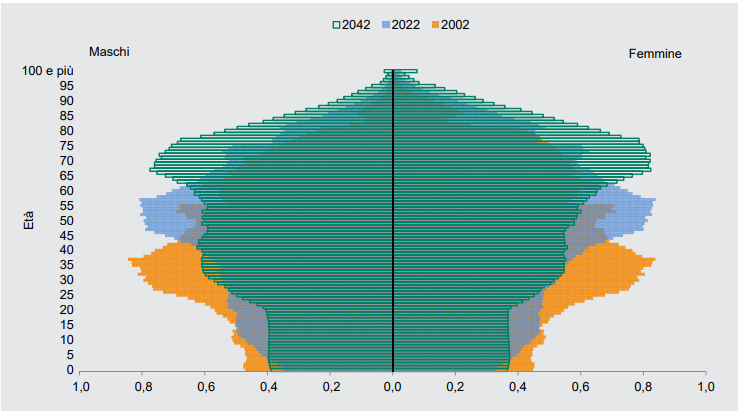
Istat, Population by gender, age and marital status, and Population and household forecasts, base 1 January 2021, ad hoc national scenario (boys on the left and girls on the right)
Why are people not having children?
Travelling through Italy and speaking with young couples, the reasons for saying “no” or “maybe later” are structural and constantly repeated. It is not solely a matter of egoism, as it is sometimes portrayed, but of material impossibility, a situation mirrored in many OECD countries.
“How can I plan for a child if my contract expires in three months?” is the phrase heard from Milan to Palermo. Youth job instability delays leaving the parental home (Italy has one of the highest average ages for leaving home in Europe, according to Eurostat data) and, consequently, delays parenthood.
The shortage of public nurseries, especially in the South, and the prohibitive cost of private childcare in the major cities of the North, act as a real “economic contraceptive”. Balancing career and family, particularly for women, remains an obstacle, due to the absence of real support policies.
The ‘flight’ and the inland areas
While the cribs remain empty, the suitcases are packed. The declining population phenomenon moves in two main directions:
- Towards foreign countries: young graduates seek adequate salaries beyond the borders (the so-called “brain drain”). Reports from organizations like the International Organization for Migration (IOM) often cite Italy as a significant source of high-skilled emigration within the EU.
- Towards the metropolises: the emptying of the outskirt provinces towards the few urban centres (like Milan, Bologna, Rome) accentuates the gap between a “fast” Italy, with developed and overly populated cities, and a “slow” one.
The inland areas (Aree Interne), which cover 60% of the national territory, face the risk of human desertification. Without local doctors, schools, and transport, those who remain are heroes, and those who leave, survivors.
Is There Hope?
Despite the prospects, there are signs of resistance. One example is the post-pandemic digitalisation, which allowed many to return to live in their home villages, while maintaining qualified employment. In addition, the PNRR (National Recovery and Resilience Plan), funded in part by the EU’s NextGenerationEU instrument, has allocated funds for nurseries and birth support. Results, however, will take years to become visible. Lastly, it’s important to consider the role of regular immigration. It is now clear that the contribution of new Italian citizens is crucial to slowing the decline, although it is not sufficient on its own to reverse it.
Conclusion
The Italy of 2050 will be a different country: smaller (an estimated 5 million fewer inhabitants), older, and likely more multicultural. Today’s challenge is not merely “to have more children“, but to redesign a social system capable of withstanding the shock of this epochal change.
“A country that does not have children is a country that has stopped looking to the future.”
Leave a Reply