America is pushing the world into China’s embrace
Authors . Opinion pieceAmerica’s flip-flop attitudes and bullying of its European allies have increasingly pushed the world into China’s embrace.
Earlier this month, Canadian Prime Minister Mark Carney issued a striking warning in Davos. “Every day,” he noted, “we are reminded that we live in an era of great-power rivalry, that the rules-based international order is fading, that the strong do what they can, while the weak suffer what they must.”
He did not call out Donald Trump’s name, seemingly an effort to save the last shred of dignity. Yet no one doubted whom he was referring to.
By contrast, China is increasingly viewed as more rational, more peaceful, and more respectful of international rules. Carney himself visited China just two weeks ago in what many observers described as an “ice-breaking” visit.
His assessment deserves serious attention, because the evidence increasingly supports it.
For decades, China has not initiated wars or orchestrated regime change abroad. The United States, by contrast, has repeatedly engaged in regime-change operations since World War II, often with destabilizing consequences that continue to shape global insecurity today. Meanwhile, U.S. military spending is projected to increase by more than $500 billion by 2027, pushing total defense expenditures close to $1.5 trillion annually. In the short term, this may project power. In the long term, it signals strategic anxiety and potentially decline.
Recent developments among America’s closest partners illustrate this shift. Besides Canada, the UK has also begun seeking closer economic ties with Beijing to reduce its dependence on the United States, a move that would have been almost unthinkable without Trump’s confrontational and unpredictable behavior. Economic diversification, once framed as a risk, is now seen as a necessity.
The European Union is facing a similar reckoning. In response to repeated provocations, humiliation, and neglect from Washington, Brussels is reportedly reconsidering the trade arrangement reached with the United States last summer. That deal effectively amounted to Europe’s submission to American pressure: the EU committed to investing $600 billion in the U.S. over three years and importing $750 billion in American energy, roughly three times its current level. European automakers would face a general 15% tariff while accepting relatively lower U.S. industrial and safety standards. Meanwhile, European steel, aluminum, and copper exporters would still be subject to punitive 50% special tariffs.
This is not partnership. It is hierarchy.
China’s approach could not be more different. Beijing has prioritized trade, infrastructure development, and long-term stability. The forthcoming Fifteenth Five-Year Plan (2026–2030), expected to be approved this March, lays out clear strategic priorities for both government and business, offering predictability that many countries now find appealing. China is already the largest trading partner of more than 120 countries and has granted zero-tariff treatment on 100% of product categories to African nations with diplomatic ties to Beijing.
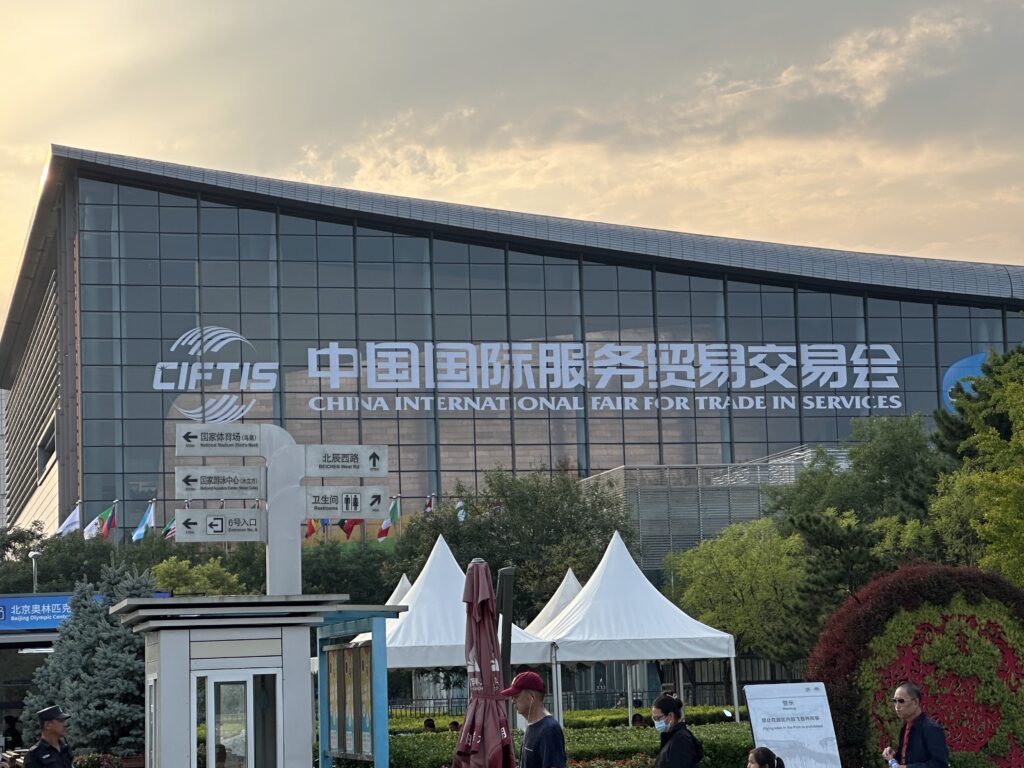
2025 China International Fair for Trade in Services, demonstrating China’s commitment to supporting globalization and cooperation rather than conflict, shot by Xiong
Which great power, then, appears more rational, more peaceful, and more respectful of rules?
The answer is increasingly clear. China emphasizes trade integration, infrastructure investment, and energy security. The United States, driven by strategic insecurity, has weakened its own credibility and created unnecessary rifts with Mexico, Canada, and the European Union. Europe, caught in a state of permanent dependency, risks becoming a geopolitical subordinate, forever seated at what many now describe as the “children’s table” in Washington’s presence.
At the same time, the costs of Washington’s aggressive posture are mounting at home and abroad. Excessive military spending and overseas interventions have fueled an explosion of national debt, which surpassed $38 trillion in early 2026, an increase of $2.25 trillion in just one year. U.S. creditors have every reason to be alarmed.
China, meanwhile, is focused on constructing long-term frameworks aimed at improving and safeguarding the welfare of its population. The United States faces a different trajectory: declining global standing and an erosion of the foundations of its hegemony.
When the Canadian prime minister flew to Beijing and spoke in Davos of building a “new strategic partnership with China to hedge against risks,” it became clear that the global political landscape was beginning to shift. European leaders, after decades of strategic weakness, now appear to be searching for alternative paths as well. After all, there is little rationale for favoring a bully over a predictable partner.
Leave a Reply