92.4 FM: The Frequency Nobody Funds
UncategorizedMedia Institutions Field Trip | May 5, 2026
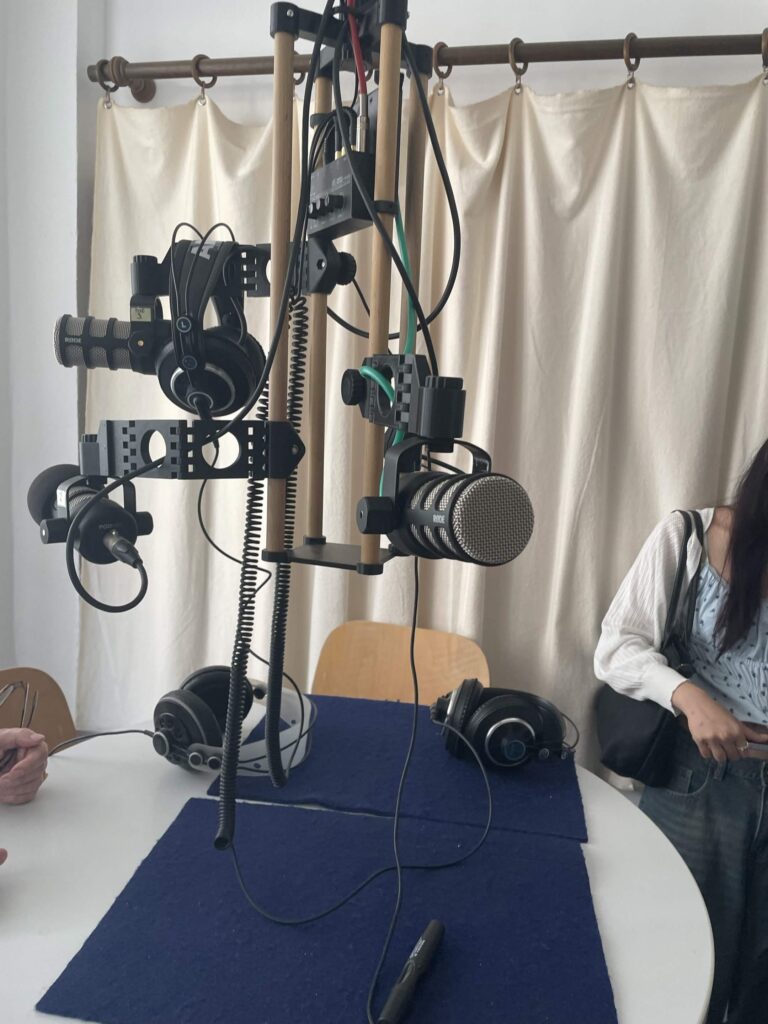
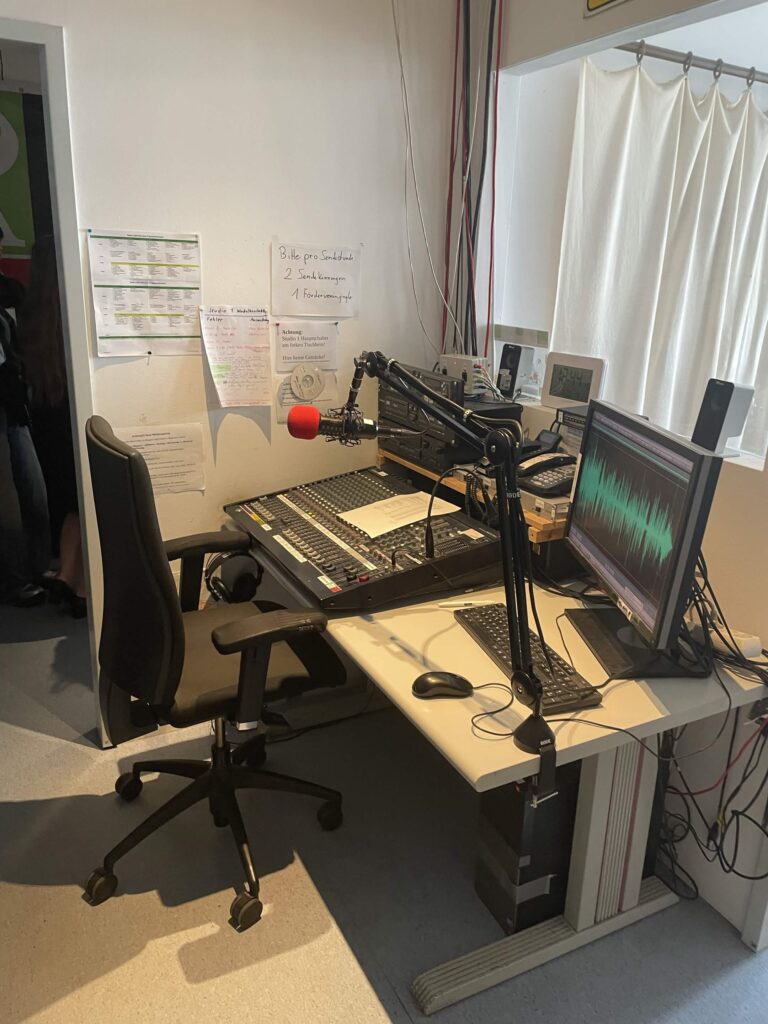
Walking into the offices of Radio LORA München, I braced myself for the kind of slick, glass-and-steel environment I associated with broadcast media. What I found instead stopped me in my tracks: cables snaking across the floor, handwritten schedules pinned to the walls, plants crowding the windowsills, and a recording studio where microphones hung from the ceiling.
LORA (short for Local Radio) is Munich’s only community radio station. Founded in 1986 by members of social and cultural initiatives frustrated with the limits of mainstream broadcasting, it took seven years of advocacy, fundraising, and bureaucratic persistence before it finally got its FM frequency in 1993. Its very first broadcast lasted 26 minutes before another station challenged its claim to the signal.
Karin Bergs, a long-time volunteer who gave us our introduction, told the story with a kind of weary pride. Near-bankruptcy in 1994. A fine of over €10,000 plus court costs for failing to broadcast the legally required station identification once a day. A complicated sharing arrangement on 92.4 FM with a Christian radio station (Radio Horeb, which airs the rosary after midnight) and a children’s station. Sixteen competitors during the 2004 frequency renewal, which LORA won. Digital broadcasting rights since 2012, wedged into a schedule so convoluted that nobody at the station could fully explain why it was set up that way.
And through all of it: no advertising revenue, no public license fee funding, no rich benefactor. Just over 250 unpaid volunteers.
What struck me most about LORA’s situation is a contradiction that Karin articulated with visible frustration. During the COVID-19 pandemic, when curfews made it practically impossible for volunteers to reach the studio for late-night live shows, LORA tried to suspend broadcasting. The government said no. LORA was classified as “systemrelevant” a public utility essential to social life.
“We are system-relevant,” Karin said, “but we get no money.”
In Bavaria, community radio occupies a peculiar blind spot. Other German states provide community stations with a share of the public broadcasting license fee (“Rundfunkbeitrag“). Bavaria does not! There are only two community radio stations in the entire state: LORA in Munich and Radio Z in Nuremberg. When LORA and Radio Z jointly petitioned the Bavarian State Parliament to change the media law, a politician reportedly responded in Bavarian dialect: “What do you want? This is Bavaria — we are a free country. Here, everyone can do what they want — even run a radio station.”
The implication being: freedom is its own reward. The bills, apparently, are yours to figure out.
One of the questions I had going in was about audience data, who actually listens to LORA, and how many of them are there? The answer, delivered cheerfully, was essentially: we don’t know, and we’re not especially concerned. This statement really surprised me, at LORA, the production model works almost in reverse. There are no demographics to optimize for. There is no algorithm to appease. Volunteers many of them retirees who came from entirely unrelated careers, without journalism backgrounds develop a concept, present it to an editorial conference, and if it aligns with the station’s broadly left-leaning, community-oriented ideology, they get a time slot. From there, they handle everything for A to Z: research, interviews, editing, music selection, and hosting.
Visiting LORA forced me to reconsider what I thought I understood about how media organizations work. The conventional model assumes a feedback loop: content is produced, audiences respond, metrics are gathered, content is adjusted. Editors calibrate their output to maximize reach and engagement. The audience shapes the product. At LORA, this loop barely exists. Producers are often also the intended audience. The station does not broadcast at a community so much as it broadcasts as one. Karin was candid about how precarious the finances are, how the membership base is shrinking (fewer than 500 members, compared to Radio Z’s 1,500), how project-based funding is unreliable and hard to secure. The two coordinators funded by Munich’s social services department in 2024 stayed for one year and left. New ones were hired in 2026, but only until the end of the year. Everything at LORA runs on a short horizon…And yet it has been broadcasting continuously for over thirty years. In a Bavarian media landscape that seems designed to make it impossible, that is not nothing.
That said, LORA’s model is not without its tensions. The very openness that makes it valuable also makes it fragile. Without stable funding, the station depends on the goodwill of volunteers who may burn out, retire, or simply move on. The rotating cast of coordinators, each hired for just a year, means institutional knowledge is constantly being rebuilt from scratch. And in Bavaria specifically, the political will to properly support community broadcasting simply does not exist. There is something uncomfortable about a state that declares a radio station “systemrelevant” in a crisis and then returns, once the crisis passes, to funding it at zero. It suggests that community media is valued the way emergency services are valued : essential when things go wrong, invisible when things go right. LORA’s existence is quietly acknowledged as necessary; its survival, however, is treated as its own problem to solve.
What the visit left me with is not a tidy lesson but a genuine unease. If a media organization this clearly useful, this deeply embedded in its community, and this stubbornly committed to public interest broadcasting can barely keep its lights on after thirty years and what does that say about the conditions we have created for independent media? And what are we prepared to lose if stations like LORA eventually cannot hold on?
Leave a Reply