Aurel Samsom – Blogpost 3
UncategorizedLearning journalism by doing journalism: Media School Bayern as a working classroom
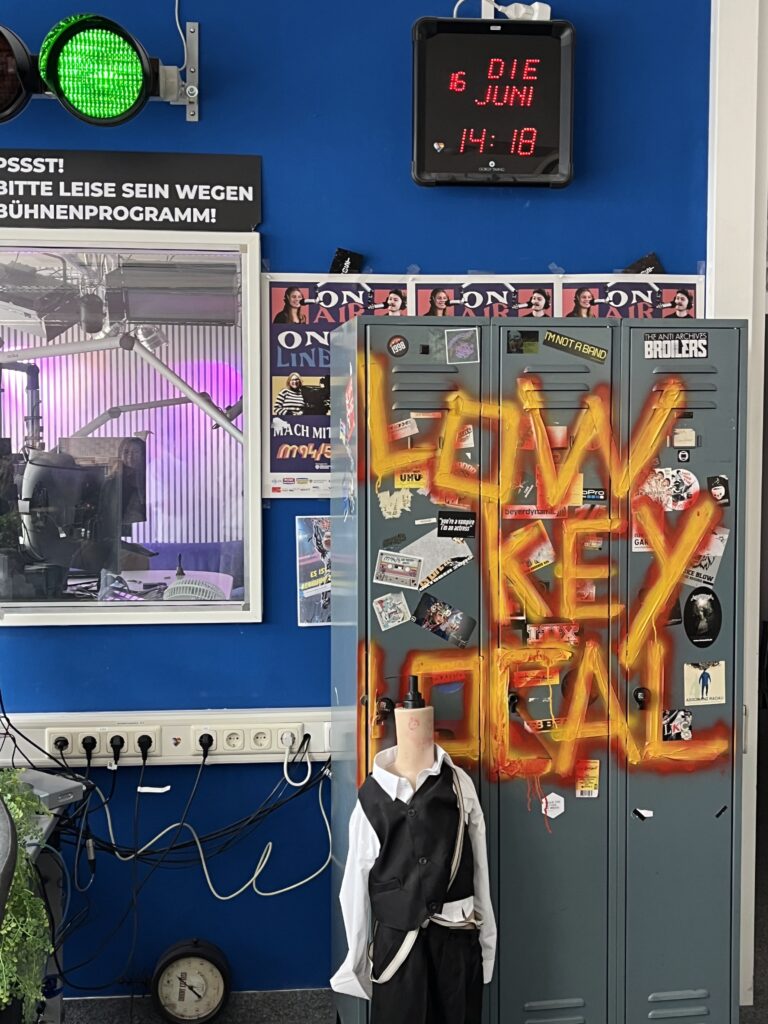
During our visit to Media School Bayern, what stood out most to me was that the organisation did not feel like a traditional school. It felt more like a working newsroom where education and production happen at the same time. Students were not only learning about journalism; they were expected to practise it. This makes Media School Bayern an interesting case within journalism education, because it blurs the boundary between classroom, newsroom and media organisation.
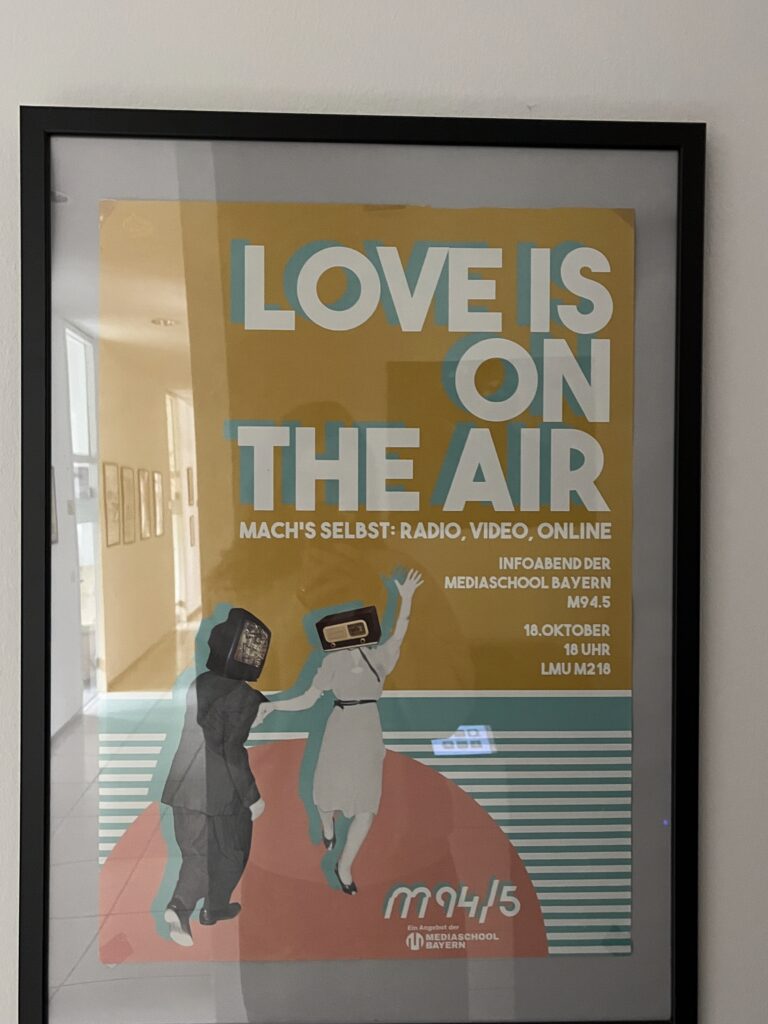
Media School Bayern presents itself as a place where young media makers can develop practical skills in audio, video, web, podcasting and social media. On its website, the organisation describes its training model as a combination of courses, workshops and daily editorial work at M94.5 and max neo (Media School Bayern, n.d.). The Bayerische Landeszentrale für neue Medien, also known as the BLM, describes M94.5 in Munich and max neo in Nuremberg as platforms for the “media makers of tomorrow”. According to the BLM, these training channels started in 1996 and have since become important elements of the Bavarian media landscape (Bayerische Landeszentrale für neue Medien [BLM], n.d.-b).
This practical model was also visible during the visit. Julius explained that students have a lot of freedom and can produce their own media. In my notes I wrote down phrases such as “produce media on your own”, “students are very free” and “fear of failing, not here”. These remarks reveal the core of the educational model. Media School Bayern seems to believe that young journalists learn best when they are trusted with real responsibility. Instead of only practising through artificial classroom assignments, students work on actual radio shows, videos, podcasts and online content.
This approach is strongly connected to the organisation’s role in education. The BLM states that young people can gain their first experience in Media School Bayern’s own broadcasting and production studios under professional guidance. They can experiment with new programme formats, while online platforms such as Facebook, YouTube and other digital applications are integrated into the daily editorial routine (BLM, n.d.-b). This is important because journalism today is no longer limited to one medium. The restructuring of the former AFK into Media School Bayern in 2018 was explicitly linked to the digital transformation of media. The new training plan focused on more social media, more YouTube and more online production, while the strict separation between radio, television and online was removed (BLM, 2018).
This also explains one of Julius’ comments during the visit: “only audio does not work anymore.” At first, this sounded like a simple statement about changing formats. But analytically, it says something larger about the German media landscape. Media organisations can no longer train young journalists for radio, television or online separately. Audiences move across platforms, and journalists are expected to do the same. Media School Bayern therefore prepares students not only to become radio presenters or video journalists, but to become flexible media professionals.
The organisation also plays a role in democracy, although this role is indirect. A democracy depends on people who can produce, understand and critically evaluate media. Media School Bayern contributes to this by training young journalists before they enter the professional field. The BLM connects the organisation to practical talent development for the Bavarian media sector and describes it as a way for young people to enter the media industry (BLM, n.d.-b). In that sense, Media School Bayern is not just an educational project. It is part of a broader democratic media infrastructure that supports media competence, journalistic talent and public communication.
The journalistic values of the organisation can be understood through this combination of practice and responsibility. The website emphasizes professional guidance, editorial work, media competence and the development of young talent (Media School Bayern, n.d.). In a broader German context, these values connect to the principles of the German Pressekodex, which stresses truthfulness, respect for human dignity and journalistic care in research and publication (Deutscher Presserat, n.d.). The BLM also states that journalistic editorial media must check information before publication with care regarding content, origin and truth, and that the Pressekodex is an important reference point for these standards (BLM, n.d.-a). During the visit, I also noticed that Media School Bayern does not seem to treat journalism as simply creating content. The focus was on learning how media works, how to produce responsibly and how to understand different platforms.
One of the most positive aspects of the organisation is that students seem to be allowed to experiment without the constant pressure of commercial success. Julius said that “it is not about the clicks”. In today’s media environment, that is a remarkable statement. Many newsrooms are strongly influenced by audience numbers, engagement and algorithms. Media School Bayern can partly resist that pressure because it is structured differently. The BLM is the main shareholder and, according to its own information, currently holds 61 percent of the shares. Other public and private media actors are also involved in the organisation (BLM, n.d.-b). This gives Media School Bayern a stronger educational and public function than a purely commercial media company.
At the same time, this should also be viewed critically. If students are trained in an environment where clicks are not central, the question is whether they are fully prepared for the reality of many professional newsrooms. Commercial pressure, audience analytics and social media performance are now part of everyday journalism. Media School Bayern’s protected environment is valuable, because it allows students to focus on quality and experimentation. But it may also make the transition to a more competitive media industry more difficult.
Another critical point concerns independence and quality control. Because students produce real media content, freedom must be balanced with editorial responsibility. The fact that experienced professionals guide students is therefore essential. Still, the model raises an important question: how much freedom can young journalists have before quality or accuracy becomes vulnerable? This is especially relevant when the organisation presents itself as a place with few limits and little fear of failure. A safe learning environment is positive, but journalism also requires verification, accountability and careful editorial judgement.
The organisation’s funding structure also deserves reflection. Public support and the involvement of major media partners make the model possible, but they also raise questions about independence. According to the BLM, Media School Bayern has many public and private shareholders, including broadcasters and media companies (BLM, n.d.-b). During the visit, it was said that stakeholders do not have influence over the content. That is reassuring, but it remains important to ask how this independence is protected in practice. For a journalism education organisation, independence must not only be claimed; it must be structurally guaranteed.
Overall, I experienced Media School Bayern as a convincing example of learning by doing. Its strongest quality is that it trusts young people with real responsibility. Students are not treated as passive learners, but as beginning journalists who can already contribute to public media production. This makes the organisation valuable for education and for the Bavarian media landscape. However, its strength is also its main challenge. A model built on freedom, experimentation and protection from commercial pressure must constantly make sure that students also learn the harder parts of journalism: accuracy, independence, audience awareness and accountability.
Media School Bayern shows that journalism education can be more than classroom instruction. It can be a working newsroom, a training space and a public media platform at the same time. That is what makes the organisation interesting. It does not only teach students how journalism works. It asks them to practise journalism before they fully become journalists.

References
Bayerische Landeszentrale für neue Medien. (2018, July 24). AFK wird MEDIASCHOOL BAYERN: Neuer Name, neuer Ausbildungsplan: Mehr Social Media! Mehr YouTube! Mehr Online! Retrieved June 23, 2026, from
Bayerische Landeszentrale für neue Medien. (n.d.-a). Journalistische Sorgfaltspflicht. Retrieved June 23, 2026, from
https://www.blm.de/de/wir-regulieren/journ_sorgfaltspflicht.cfm
Bayerische Landeszentrale für neue Medien. (n.d.-b). Media School Bayern. Retrieved June 23, 2026, from
https://www.blm.de/de/wir-foerdern/aus-und-fortbildung/mediaschool-bayern.cfm
Deutscher Presserat. (n.d.). Pressekodex. Retrieved June 23, 2026, from
https://www.presserat.de/pressekodex.html
Media School Bayern. (n.d.). Ausbildung an der MEDIASCHOOL BAYERN. Retrieved June 23, 2026, from
https://www.mediaschool.bayern/map/popup/4
Leave a Reply